



Introduction
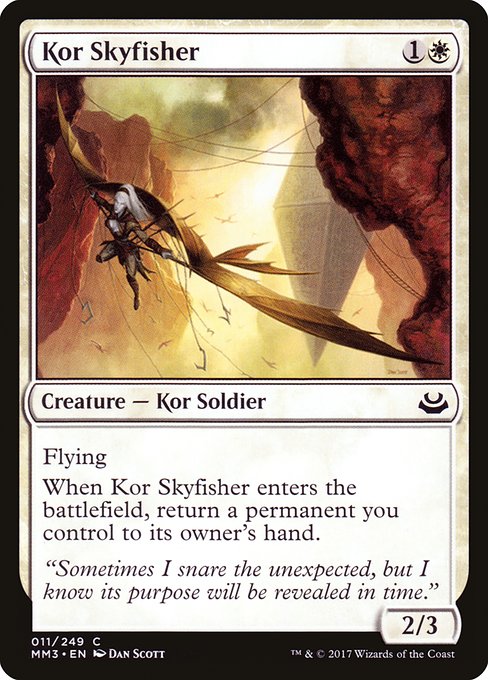
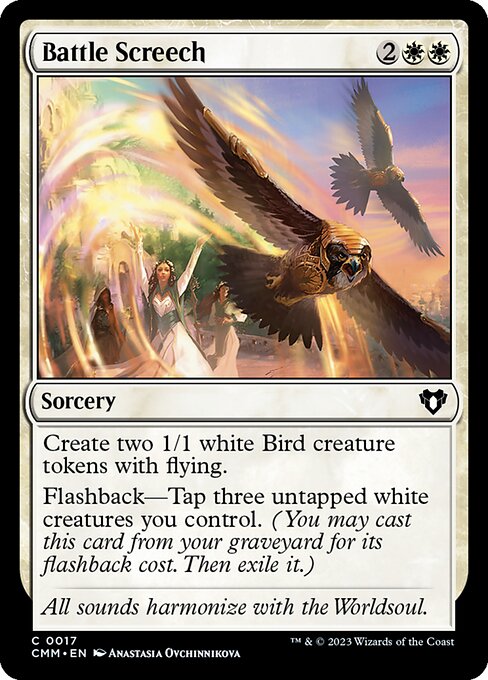
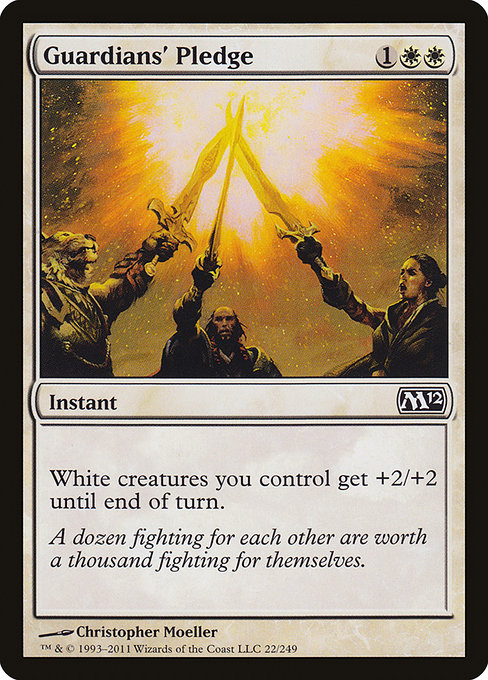
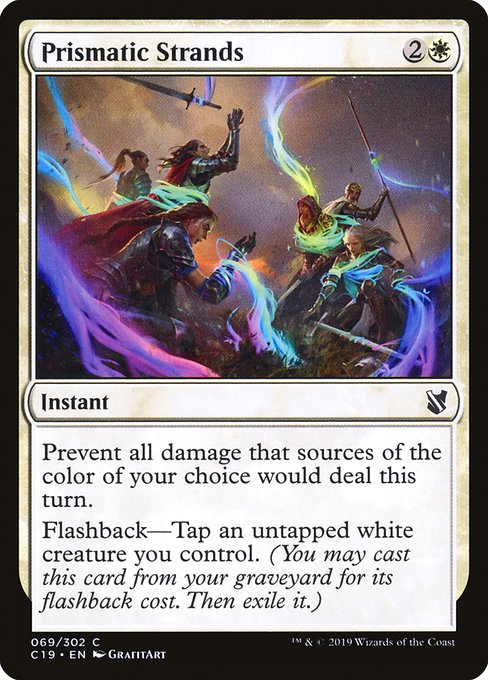
White Aggro holds a modest 2.1% of the field, a small share for a deck that keeps showing up at the top of events. Giovanni Favetta took it to 2nd place at the Paupergeddon Summer 2026 main event on July 11, Niederschatten won the July 26 MTGO Challenge with it, and copies have kept placing near the top of the Challenge series since. The plan is a mono-white creature swarm: cheap bodies such as Thraben Inspector and Kor Skyfisher pay for themselves as they enter, Battle Screech adds a flock of fliers from a single card, and Guardians' Pledge makes the whole team lethal while Prismatic Strands blanks the opponent's attempt to race back.
The deck beats creature-based aggro and tempo decks that fight on the board, and the fair midrange decks that try to trade with it one for one. It is favored against Mono Red Rally, Black Sacrifice, Bogles, Blue Terror, Grixis Affinity, Gruul Ramp, Mono Blue Faeries, Jund Wildfire and Mono Red Madness, and slightly favored against Dimir Faeries.
It struggles against combo decks that ignore the board, against control and ramp decks that go over the top of a creature swarm, and against the one aggro deck that goes wider than it does. It is slightly unfavored against Elves, and unfavored against Ephemerate Tron, Gruul Ponza, Cycle Storm, Jeskai Ephemerate, Golgari Gardens, Familiars, Spy Combo, Monster Tron, Ruby Storm and Naya Gates.
General Strategy
White Aggro wants more creatures on the battlefield than the opponent can answer, at every point of the game, and wants each of those creatures to have already paid for itself by the time it dies. Thraben Inspector, Novice Inspector and Lunarch Veteran come down immediately and leave a Clue or a stream of life behind them, Kor Skyfisher and Raffine's Informant follow while drawing or recycling cards, and Battle Screech turns a single card into a flock of fliers. None of these creatures is scary on its own, and that is the point: the opponent has to spend a real card on every one of them or watch the board grow until Guardians' Pledge or a mid-combat Leonardo, Big Brother makes a harmless-looking pile of attackers lethal in one swing. The single most important thing the pilot does is keep adding bodies every turn while banking value from each one, so that the pump spell is always a threat and the opponent is never allowed a turn in which nothing happened. Prismatic Strands covers the other half of the job: when the opponent tries to race the swarm rather than answer it, one cast wipes out a whole turn of damage from the color of your choice.
The engine is the set of cheap creatures that bank something as they enter and the one creature that lets you bank it again. Thraben Inspector and Novice Inspector each leave a Clue you can cash in for a card when the mana is free, Raffine's Informant draws and discards on arrival and grows when the discard is a nonland card, and Lunarch Veteran pays out a point of life for every other creature you control that enters after it. Kor Skyfisher is what turns those one-shot triggers into a loop: it has to return one of your permanents when it enters, so you hand back a creature whose trigger has already fired and recast it for the trigger again, converting spare mana into cards and life while the board keeps growing.
A game runs in three phases. The setup is the one- and two-mana creatures, deployed nearly every turn, so that by the middle turns you have several bodies and a Clue or two in reserve. The payoff is Battle Screech: cast it, then flash it back at once by tapping the two fresh Birds and one more white creature, and four fliers arrive in a single turn. The close is combat damage from that board, either boosted by Guardians' Pledge as a burst of extra damage across every white creature you control, or by Leonardo, Big Brother entering the attack after blockers are already declared, at a size set by the whole board behind him.
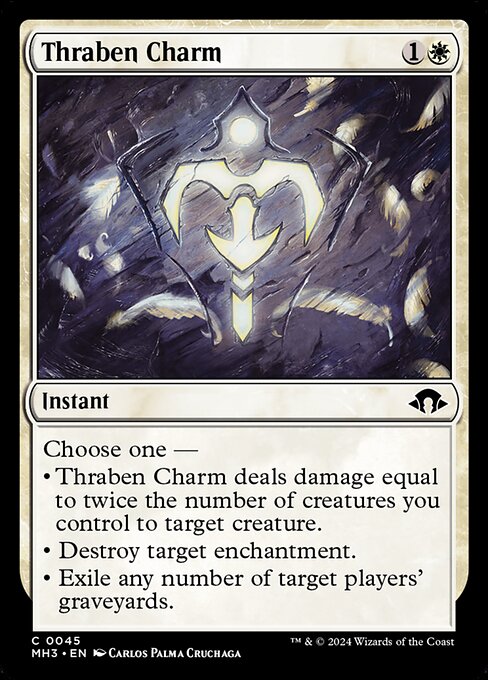
When removal or a sweeper breaks the first wave, the deck rebuilds rather than folding. Banked Clues become cards, Lunarch Veteran comes back from the graveyard through Disturb as Luminous Phantom, a flier that gains life whenever another of your creatures leaves the battlefield, and a Battle Screech already in the graveyard makes two more Birds for no mana at all once three white creatures are untapped. Prismatic Strands blanks one turn of one color's damage to buy the rebuild time, and Thraben Charm clears the single blocker that would hold the renewed attack back.
Two weaknesses shape how you play every game. The board is many small white bodies, eight of them at one toughness, so a cheap sweeper or a mass -1/-1 effect can undo several turns of work with one card, and the main defense is to hold back a rebuild rather than commit the entire hand, though Prismatic Strands can blank a damage-based sweeper outright. And the deck has almost no way to touch a noncreature permanent: artifacts are untouchable in game one, and enchantments fall only to one mode of Thraben Charm, so an opposing engine that does not need to attack or block has to be raced rather than answered.
The Cards
Thraben Inspector
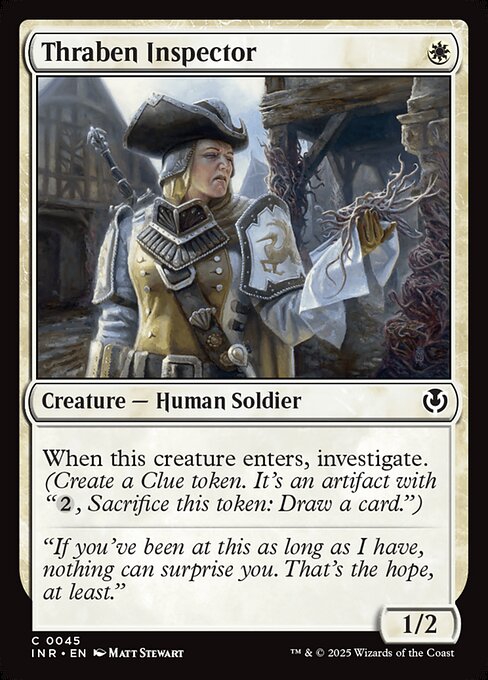
Thraben Inspector and Novice Inspector are the same card under two names in everything this deck cares about, differing only in creature type, one a Human Soldier and the other a Human Detective, a one-mana 1/2 that brings a Clue with it, and we run all eight because the deck's edge lives in the first two turns. The body is the part people undervalue: 2 toughness blocks a 1-power attacker forever and survives the small -1/-1 effects that wipe out the Birds. The Clue is the deck's mana sink, two mana for a card whenever the hand runs dry, and it is the reason handing an Inspector back to your hand with Kor Skyfisher or Spider-Man, Web-Slinger is a gain rather than a loss: the recast leaves a second Clue behind. Crack Clues in the gaps, on an opponent's end step when you had nothing better to do with the mana, rather than spending a main phase on them.
Lunarch Veteran
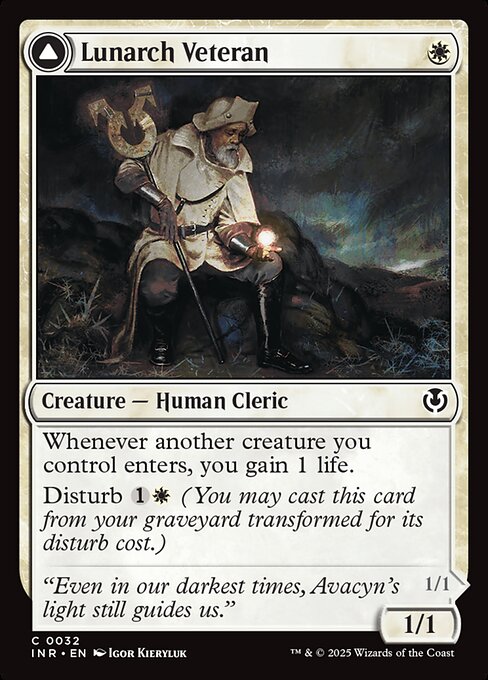
A one-mana 1/1 that gains you a point of life every time another creature you control enters. In a deck that recasts Inspectors and makes Birds in pairs, that adds up to five or six life over a normal game, which is often exactly the margin in a race. The second half is the reason the card is a two-for-one: once it is in the graveyard, Disturb lets you cast it again for two mana as Luminous Phantom, a 1/1 flier that gains life whenever another creature you control leaves the battlefield, which pairs neatly with the returns of Kor Skyfisher, Leonardo, Big Brother and Spider-Man, Web-Slinger. The Phantom is exiled rather than binned when it dies, so each copy is exactly two bodies, and both faces are white creatures that can be tapped toward a flashback.
Raffine's Informant
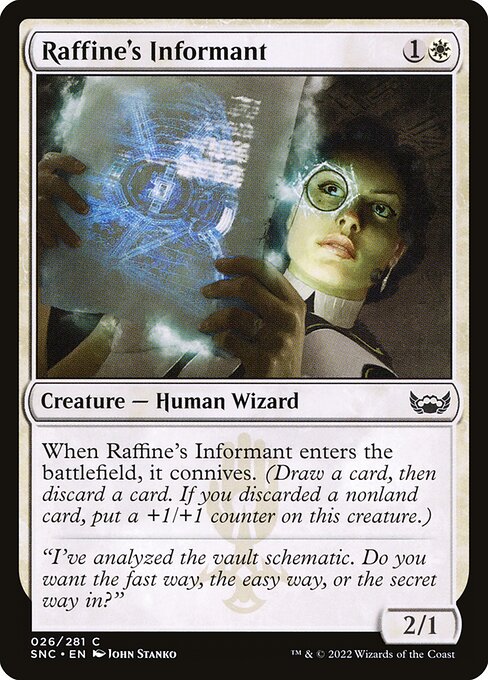
Role Assignment
White Aggro is a linear, tempo-positive creature deck with low inevitability: it wins games in which it got ahead early and kept the pressure on, and loses the ones that drift into a late game where the opponent's cards outclass a pile of 1/1s. Every matchup is decided along the same four axes: how cheaply and how often the opponent can sweep or shrink a wide board of one- and two-toughness creatures, whether their one-for-one removal keeps pace with bodies that replace themselves through Clues, Disturb and Bird pairs, the race math around Prismatic Strands and drip lifegain, and whether they can present blockers bigger than 3 power before a pump spell turns a stalled board lethal.
Vs. Aggro. Against other aggressive decks you are usually the control. Your creatures are small but they are many and they block well, Lunarch Veteran turns every deployment into life, and Prismatic Strands erases the turn on which they commit everything. The play that shows the role is holding Kor Skyfisher back as a blocker and casting Strands during their biggest attack, naming their color, so that their whole turn deals nothing while your fliers keep chipping. Once their hand is empty the roles flip and the Birds close.
Vs. Midrange. Against decks built on efficient one-for-one removal and larger creatures you are the beatdown, but the fight is on the card-count axis rather than the damage axis. Every removal spell they spend on an Inspector has already been paid for by its Clue, and Kor Skyfisher recasting a spent creature means you are producing more bodies than they are drawing answers. The defining play is cashing Clues on their end step and continuing to add creatures every turn until the flock of Birds is wide enough that a single Guardians' Pledge or a sneaked Leonardo, Big Brother goes over the top of blockers that were holding the ground.
Vs. Control. Against sweepers and counterspells you are unambiguously the beatdown, and your low inevitability means you cannot afford to let the game go long. The axis is the sweeper: commit enough creatures to force it, but hold a rebuild in reserve rather than the entire hand. The play that shows the role is casting Battle Screech and flashing it back in the same turn to put four fliers onto the board in one motion, while keeping 's Disturb, a Clue or two banked on the battlefield and the second flashback in the graveyard so that the sweeper they finally resolve is answered by a second wave instead of by nothing. Against a damage-based sweeper, naming its color saves the board outright.
Play Patterns
- Flash Battle Screech back the same turn you cast it whenever a third untapped white creature is on the battlefield. The flashback costs no mana, only tapping three untapped white creatures, and the two Birds you just made are legal payers: summoning sickness stops a creature from attacking or using its own tap abilities, not from being tapped to pay a spell's cost. Waiting a turn to untap gains you nothing and gives removal and sweepers a free window at two Birds instead of four. The planning happens before combat: the third payer has to be untapped, so either cast a one-drop first and tap it alongside the Birds, keep one creature home from the attack, or cast the Screech precombat and accept that one creature trades its attack for two more fliers. On five lands, one-drop plus Screech plus flashback is the standard line.
- Cast Prismatic Strands on your own attacks too: after blockers are declared, name the blocking color and every blocker deals no damage this turn. Strands prevents all the damage a color's sources would deal for the turn, in either direction, so an all-out attack into a bigger board kills their blockers and loses nothing back. Pilots who treat it purely as a defensive card miss the turns on which it is a one-sided sweeper. Two checks before you do it: if their blockers are white, naming white blanks your own attackers as well, and colorless blockers cannot be named at all. Afterward, keep one white creature out of the attack whenever you can, since the copy now in the graveyard casts again for the cost of tapping it.
- Hold Leonardo, Big Brother for the declare blockers step and Sneak him in by returning an unblocked attacker. Blocks are already locked in by then, so he enters tapped and attacking with no blocker assigned and connects at full size, and the returned creature is usually an Inspector whose recast re-banks a Clue after combat. Hardcasting him on curve presents an obvious removal target before he has dealt a point of damage. The line looks like this: Thraben Inspector on the first turn, Lunarch Veteran and Novice Inspector on the second, then on the third turn attack with all three and, once the opponent has declared blocks, pay one white mana to Sneak Leonardo, Big Brother in by returning whichever attacker went unblocked. With the returned, he arrives as a 3/3 behind the two remaining creatures, the swing deals 5 instead of 3, and the second main phase recasts the Inspector for another Clue with mana to spare. Remember that the creature you return stops counting toward his power, but that bonus is a flat +1/+0 for each other creature, so any body you return costs him exactly one power; return the smallest unblocked body because the damage you give up is that creature's own.