



Skip to content
Deck Guides
  1. Pauper
  2. /Dimir Faeries
Sign in
PrimerMulligansSideboardMatchupsCommunity


© 2026 Deck Guides LLC
AboutTerms of ServicePrivacy PolicyRefund PolicySupport
PrimerMulligansSideboardMatchups
Baleful Strix card art representing Dimir Faeries

Dimir Faeries

blue manablack mana

November 2026 · 9.6% Meta · 3 hr 30 minNovember 2026 Version · 9.6% Meta · 3 hr 30 min read

Dimir Faeries is a blue-black aggro-control deck: it pressures with cheap fliers and ninjas, backs them with counterspells and cheap removal, and settles into a grindy control game when the attack stalls. It lands cheap fliers such as Faerie Seer, Spellstutter Sprite, and Baleful Strix, each of which pays off the moment it enters, then attacks with them and swaps an unblocked flier home for Ninja of the Deep Hours, drawing a card off the hit while the returned creature comes back later for a fresh trigger. Counterspell, Snuff Out, and Cast Down answer whatever the opponent does in the meantime, and the small fliers and ninjas chip the game to a close.

Decklist

Creatures (18)

  • 3Faerie Seerblue mana
  • 2Augur of Bolas1 manablue mana
  • 4Baleful Strixblue manablack mana
  • 4Spellstutter Sprite1 manablue mana
  • 1Mukotai Ambusher3 manablack mana
  • 2Ninja of the Deep Hours3 manablue mana
  • 2Thorn of the Black Rose3 manablack mana

Instants (18)

  • 3Brainstormblue mana
  • 2Dispelblue mana
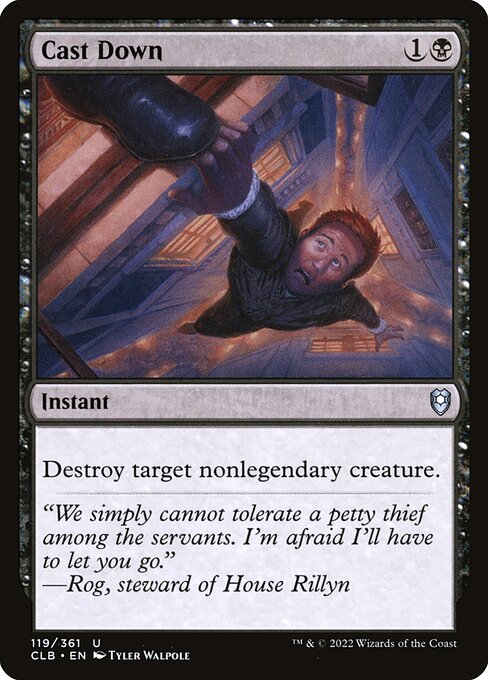
  • 3Cast Down1 manablack mana
  • 4Counterspellblue manablue mana
  • 2Plunder the Trollshaws1 manablue mana
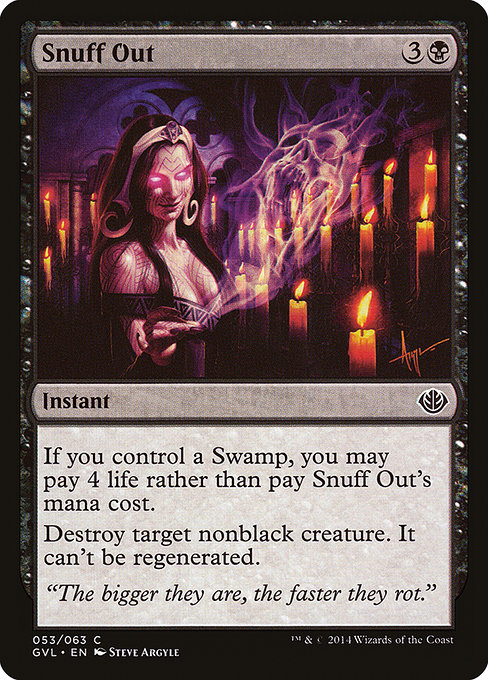
  • 4Snuff Out3 manablack mana

Sorceries (6)

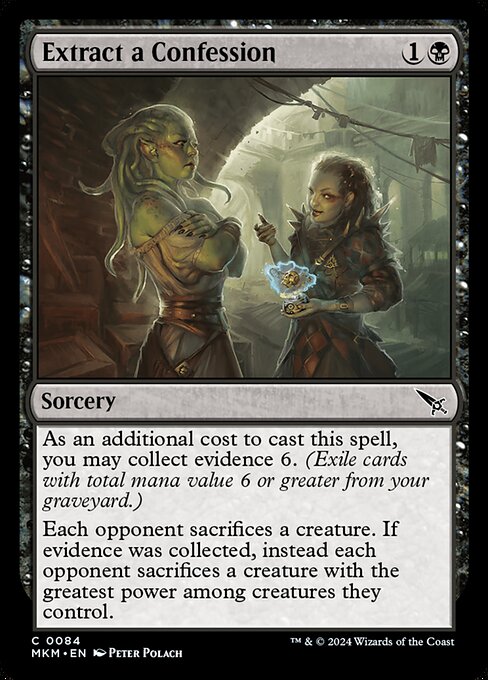
  • 1Extract a Confession1 manablack mana
  • 1Arms of Hadar3 manablack mana
  • 4Lórien Revealed3 manablue manablue mana

Lands (18)

  • 1Bojuka Bog
  • 4Contaminated Aquifer
  • 1Dimir Aqueduct
  • 10Island
  • 1Seething Landscape
  • 1Swamp

Sideboard (15)

  • 4Annulblue mana
  • 3Blue Elemental Blastblue mana
  • 1Campfire1 mana
  • 3Hydroblastblue mana
  • 2Relic of Progenitus1 mana
  • 1Arms of Hadar3 manablack mana
  • 1Okiba-Gang Shinobi

Dimir Faeries

  1. Overview
  2. Decklist

Deck Fundamentals

  1. Introduction
  2. General Strategy
  3. The Cards
  4. Role Assignment
  5. Play Patterns

Introduction

Dimir Faeries is a blue-black aggro-control deck: cheap fliers like Faerie Seer and Spellstutter Sprite that pay off as they enter, ninjas that swap in mid-attack to draw cards, and Counterspell, Snuff Out, and Cast Down to answer what the opponent tries in between. When the attack stalls, Baleful Strix, Extract a Confession, and Thorn of the Black Rose turn it into a control deck that grinds out the long game, until the small fliers finish it. It sits at 9.6% of the field.

The deck has been a fixture near the top of recent events. barff won the November 2 Pauper Challenge, Purgatory_01 went 5-0 in a Pauper League that same day, and barff had already taken 3rd in the October 29 Challenge. At the paper CPC Championship 2026, Gavin Clark finished 3rd of 80 and Caleb Littlejohn finished 7th. The September 7 tabletop legality of Baleful Strix, printed at common for the first time, handed the deck one of its best cards.

The deck beats many creature-based aggro decks that have to walk their cheap spells into the counters and trade their creatures into deathtouch blockers, most ramp decks whose plan hinges on resolving a few expensive spells, and combo decks that have to force their key spells through Counterspell and Spellstutter Sprite. It is favored against Mono Blue Terror, Spy Combo, Elves, Ruby Storm, Bogles, Mono White Convoke, Golgari Gardens, Gruul Ponza, Jund Wildfire, and Madness Burn, and slightly favored against Mono Red Madness, Mono Red Rally, Monster Tron, and Turbo Fog.

It struggles against control decks whose own card-draw engines outlast the counter suite once the game goes long, and against midrange decks whose cheap interaction lines up well against small fliers and whose threats dodge conditional removal. It is slightly unfavored against Familiars, and unfavored against Dimir Control, Boros Moxite, Grixis Affinity, Esper Affinity, and Dimir Affinity.

General Strategy

Dimir Faeries plays half of every turn cycle on the opponent's turn. You put a cheap flier on the table, pass with mana open, and let the opponent decide whether to run a spell into Counterspell or Spellstutter Sprite. If they cast nothing worth stopping, the same mana flashes in a Sprite or kills a creature with Cast Down at the end of their turn instead, and Snuff Out can do the same for 4 life and no mana at all while you control a Swamp. The fliers attack in between, and Ninja of the Deep Hours swaps in for an unblocked one to draw a card. The priority that decides most games is keeping mana open and keeping the attack step alive at the same time, because the deck's extra cards come from creatures connecting and from the enter triggers you get by recasting what the ninjas send home. Tapping out on your own turn for a creature the opponent can answer at leisure gives up both halves of that plan.

The engine is a loop of enter triggers. Faerie Seer scries two, Baleful Strix draws a card, Augur of Bolas digs for an instant or sorcery, and Spellstutter Sprite counters a spell, all the moment they land. Once that value is spent, the creature attacks, and if it goes unblocked you pay the ninjutsu cost of Ninja of the Deep Hours to return it to hand and put the ninja onto the battlefield tapped and attacking in its place. The ninja connects and draws a card, and the returned creature gets recast for a fresh scry, draw, or counter. Every swap is therefore worth a card and a second trigger, and the fliers make it reliable because cheap ground blockers cannot stop them.

A typical game opens with Faerie Seer on the first land and an attack on the next turn, swapping the Seer for a ninja as soon as the ninjutsu mana is available while the Seer comes back to scry again. Baleful Strix joins a turn later and feeds the same swap, drawing a card every time it is recast. From there the deck holds up two mana every turn: and stop the spells that matter, and , often paid for with life off a Swamp-typed land rather than mana, removes the blockers that would shut the ninjas off. The close is pure combat: , , , , and chip in a few points a turn while the opponent's hand empties into counters and removal.

The Cards

Spellstutter Sprite
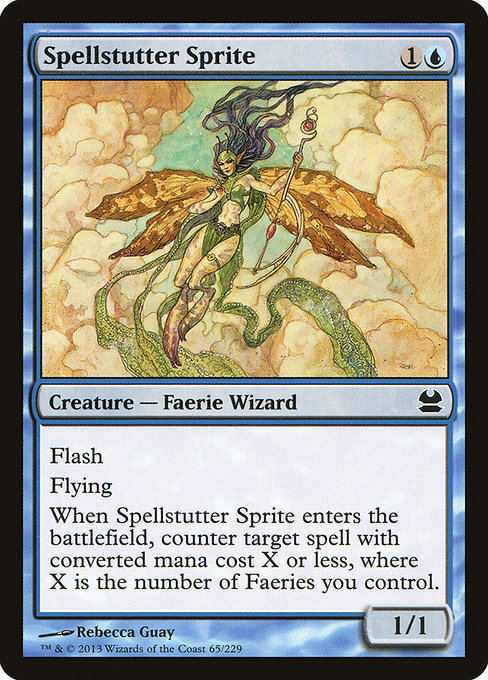
Spellstutter Sprite card

The card the deck is named for. It flashes in and counters a spell whose mana value is no greater than the number of Faeries you control, and it counts itself, so a lone Sprite answers any one-mana spell and a Sprite with Faerie Seer on the table answers two-mana spells, which covers most of what gets cast in the first few turns of a Pauper game. The Faerie count is checked again when the trigger resolves, so a Seer dying in response to the trigger lets a two-mana spell through: protect the count until the counter has resolved. Once the trigger is spent the Sprite is the perfect creature to attack with and return by ninjutsu, because recasting it is another counter.

Faerie Seer

Faerie Seer card

The one-mana flier that starts the whole plan: it attacks on the second turn, gets swapped out for a ninja, and comes back to scry again. It is also the second Faerie that stretches Spellstutter Sprite to two-mana spells, and its scry is the cheapest way to clean up the cards Brainstorm leaves on top. Treat it as a body you are happy to see die to removal, since every answer spent on it is one not spent on a ninja.

Baleful Strix
Baleful Strix card

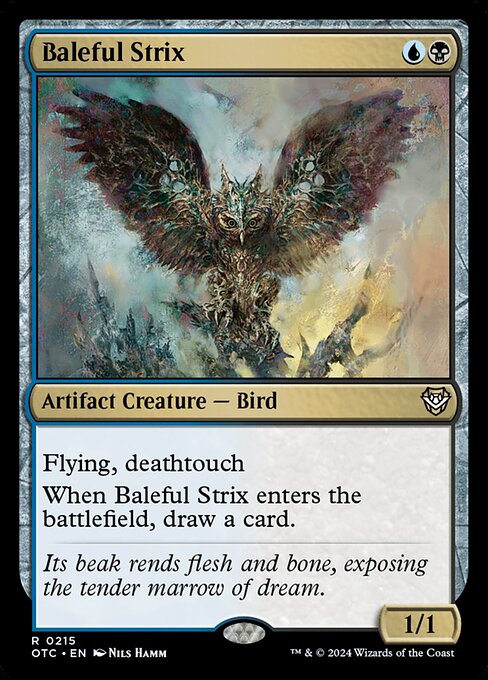
A flying, deathtouch artifact creature that draws a card as it enters, which makes it the best ninjutsu enabler in the deck (every recast is another card) and its best blocker, since deathtouch trades with nearly any ground attacker regardless of size. It wants black mana on the second turn, so it is the main reason to find a black source early. Its artifact type does expose it to artifact removal, a class of answer the rest of the creatures ignore apart from .

Role Assignment

Dimir Faeries is an interactive and tempo-positive aggro-control deck that has medium inevitability: it generates card advantage through the attack step and the monarch, backed by raw draw spells like Lórien Revealed, and its interaction is dense and cheap (Counterspell, Spellstutter Sprite, Dispel, Snuff Out, Cast Down, Extract a Confession). Every matchup is fought on some mix of five axes: the stack fight, how the opponent's removal lines up against 1-toughness fliers, whether they can contest the attack step, who wins the long game of card flow, and how much your life total can be spent on Snuff Out and the monarch. Which of those axes dominates decides the role.

Vs. Aggro. Against aggressive creature decks you are the control. Their clock is faster than yours, their cheap damage-based removal trades up against your fliers, and the 4 life for Snuff Out plus the attacks the monarch invites are exactly the resources they want you to spend. Trade early and often: Cast Down on the first attacker that matters, Baleful Strix drawing its card and then blocking with deathtouch, Arms of Hadar on a board of small creatures, and Counterspell held for their payoff rather than their first creature. The play that defines the role is passing with two mana open and flashing Spellstutter Sprite onto a one-mana burn spell or creature on their turn; the ninjas and Thorn of the Black Rose wait until the board is stable.

Vs. Midrange. Against fair midrange decks the role is set by the attack step. If they cannot block fliers, you are the beatdown: swap ninjas in, draw ahead, and use the counters to protect the loop from their removal. If they have flying or reach blockers, the ninja draws dry up and you become the control, grinding with and on the blockers that matter and taking the monarch with once the crown can be held. The play that defines this matchup class is backed by a second Faerie countering the two-mana removal spell aimed at a ninja mid-combat, keeping both the creature and the card it was about to draw.

Play Patterns

  1. Count Spellstutter Sprite toward its own counter: alone it stops a one-mana spell, and any second Faerie such as Faerie Seer stretches it to two-mana spells. The trigger counts Faeries you control with the Sprite already on the battlefield, so it is never dead against cheap spells, and Faerie Seer on the first turn is what makes the Sprite answer the two-mana plays that fill out the opponent's early turns. The two common errors are mirror images: waiting for a second Faerie before using it, which holds it too long, and aiming it at a bigger spell without one, which does nothing. When the opponent's turn passes with nothing worth countering, flash the Sprite in at their end step anyway: with two lands untapped and nothing on the stack, the trigger simply has no target, you untap with a flier ready to attack, and swapping it home with Ninja of the Deep Hours on the next attack puts the counter back in your hand for the next cheap spell.

  2. Attack with the creature whose enter-the-battlefield value is already spent, and make that the body ninjutsu returns. The ninja's damage replaces the returned attacker's rather than adding to it, so the swap's real profit is the draw plus recasting Spellstutter Sprite or Faerie Seer later for a fresh counter or scry; bouncing a creature whose trigger you still want wastes the loop's whole point.

  3. Put a Swamp-typed land into play early (a basic Swamp or Contaminated Aquifer) so Snuff Out stays a no-mana kill while Counterspell stays open. Killing a creature for 4 life without tapping a land is how the deck answers two things in one turn, but that mode keys on controlling a Swamp rather than on producing black: Bojuka Bog makes black mana and still leaves you owing the full four-mana cost. And if the early lands all make only blue, the black in the printed cost is unpayable and Snuff Out cannot be cast at all. The deck also needs two untapped blue sources for on the second turn, so the Aquifer, which covers both colors and the Swamp type, is the land to play on turn one while it entering tapped usually costs nothing; fetching a basic Swamp and islandcycling for an Aquifer are the backups.

Continue to Mulligans→
3 mana
black mana
black mana
Counterspell
Spellstutter Sprite
Snuff Out
Spellstutter Sprite
Faerie Seer
Baleful Strix
Ninja of the Deep Hours
Mukotai Ambusher

When the attack step is shut off, or the board gets cleared, the deck settles into a long trading game and is comfortable there. Cast Down, Extract a Confession, and the counters trade one for one, Baleful Strix has already drawn its card and then trades its deathtouch body for any attacker, and Brainstorm and Lórien Revealed refill the hand. Thorn of the Black Rose takes the monarch so an extra card arrives on each of your end steps, and that slow trickle pulls ahead of most opponents. Whatever flier eventually sticks finishes the job.

Two weaknesses follow directly from the construction. Most of the creatures have 1 toughness (Faerie Seer, Spellstutter Sprite, Baleful Strix), so a one-damage sweep, a repeatable pinger, or a small -1/-1 effect clears the board for almost nothing, and overextending into one is the fastest way to lose. The other is that the ninja draws need an attacker to connect: ground blockers do not matter against fliers, but a flying or reach blocker shuts off ninjutsu and most of the deck's card flow with it, which is exactly when the removal has to be spent on a blocker rather than saved for a threat.

Mukotai Ambusher

Augur of Bolas

Augur of Bolas card

Four of every ten cards in the deck are instants or sorceries, so the Augur finds one more often than not and functions as a two-mana creature that replaces itself. It does not fly and is not a Faerie, so it rarely enables a ninja or grows a Sprite; its job is the 3-toughness body that blocks small ground creatures while the fliers attack, and the extra counter or removal spell it digs up.

Ninja of the Deep Hours

Ninja of the Deep Hours card

Printed at four mana, it is almost always put onto the battlefield through ninjutsu for two by returning an unblocked attacker, and it draws a card every time it deals combat damage to the opponent. Activate ninjutsu only after blockers are declared, when the returned creature is actually unblocked, and prefer to return the creature whose enter trigger is already spent. As long as the sky stays clear it is a two-power creature that draws a card a turn, and the opponent's removal is usually pointed at it first.

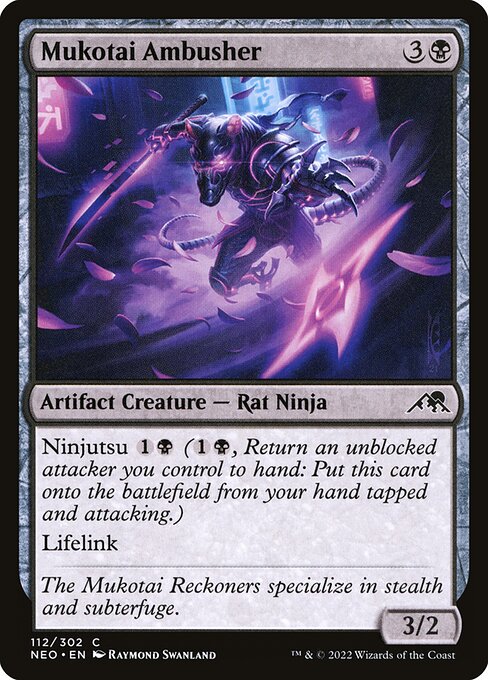
Mukotai Ambusher

Mukotai Ambusher card

A lifelink ninja that enters through ninjutsu for two mana and swings life totals by six every time it connects: three damage dealt and three life gained. It is the racing tool for games where the opponent is burning you out or attacking past your fliers, and its 2 toughness survives the one-damage effects that clear the rest of the board. It draws nothing, so against slow opponents it is the weakest ninja to swap in.

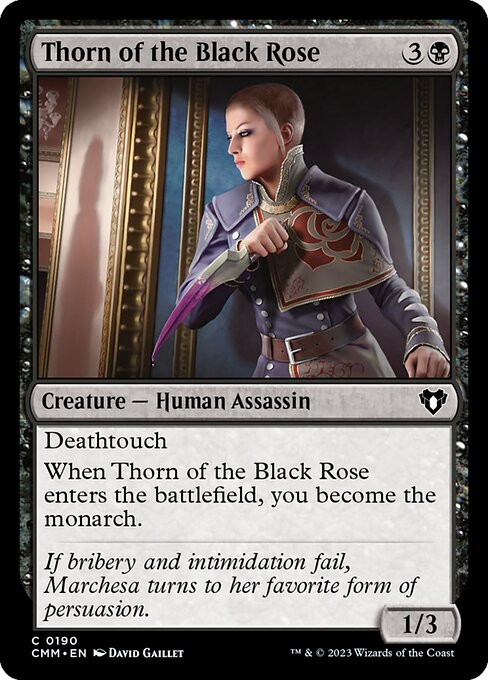
Thorn of the Black Rose

Thorn of the Black Rose card

A four-mana 1/3 deathtouch creature that makes you the monarch, which draws an extra card at each of your end steps for as long as no opposing creature deals combat damage to you. Its deathtouch body plus a flier on defense usually holds the crown against one or two ground attackers, and the steady draw is how the deck wins the long trading games. Cast it only when your board can keep the monarch; landing it while behind hands the opponent the extra cards instead.

Brainstorm

Brainstorm card

One-mana card selection that is at its best when a shuffle or scry follows it: islandcycling Lórien Revealed or cracking Seething Landscape shuffles away the two cards you put back, and a recast Faerie Seer can bottom them. Cast it at the end of the opponent's turn when you have mana to spare, or in response to discard to protect a card in hand.

Lórien Revealed

Lórien Revealed card

Printed as a five-mana draw three, it spends the early game as a one-mana islandcycler that finds any Island card, which includes Contaminated Aquifer, so it doubles as a way to find black mana and a Swamp-typed land. Late in the game, when the counters are no longer the best use of five mana, the full cast refills the hand and is the deck's main mana sink. Cycle it early for the land drop; hold it when you are already on four or five lands with a stable board.

Plunder the Trollshaws

Plunder the Trollshaws card

A two-mana instant that draws a card, and when flashed back from the graveyard for four mana it draws two more, so a single copy is worth three cards over a game. Both halves are instants, so they can wait until the end of the opponent's turn, after the counter mana has gone unused. The flashback is the late-game mana sink alongside Lórien Revealed.

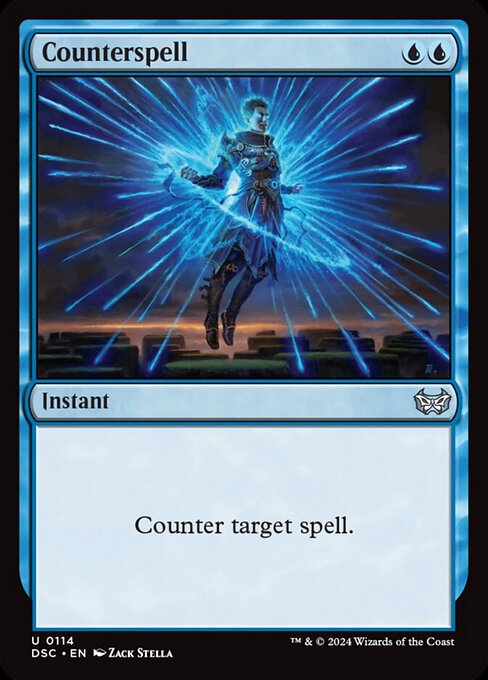
Counterspell

Counterspell card

The hard counter, and the reason the deck wants two untapped blue sources on the second turn. Save it for the spell that actually decides the game (the opponent's card-draw engine, their biggest threat, or the removal aimed at a ninja mid-attack) rather than the first spell they cast; Spellstutter Sprite handles the cheap ones.

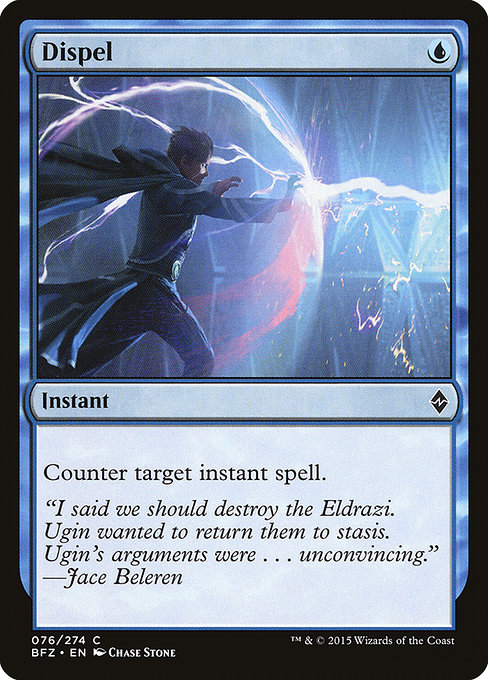
Dispel

Dispel card

A one-mana counter for instants that protects a creature from instant-speed removal, wins the fight over an opposing counterspell, and stops a combat trick. It is the cheapest way to keep a ninja alive through the attack step, which is where the deck's card draw lives. Against opponents who cast few instants it is a dead card and the first cut after sideboarding.

Snuff Out

Snuff Out card

Printed at four mana, but with a Swamp-typed land in play (a Swamp or Contaminated Aquifer) you can pay 4 life instead and destroy a nonblack creature without tapping anything, so you kill a blocker and still hold up Counterspell on the same two lands. That life is a real cost against decks that attack your face or burn you out, so against those opponents hard-cast it when the mana is spare and save the free mode for the turn it buys the game. It cannot touch black creatures, which is what Cast Down is for.

Cast Down

Cast Down card

Two-mana instant removal for any nonlegendary creature, the clean answer to the black creatures Snuff Out cannot target and to threats too big to trade with in combat. Hold it for the creature that would otherwise block your fliers or race your clock, and let Baleful Strix and Spellstutter Sprite handle the early bodies where they can.

Extract a Confession

Extract a Confession card

A two-mana sorcery that makes the opponent sacrifice a creature of their choice. It ignores hexproof and protection, which makes it the answer to a lone threat the targeted removal cannot reach. As you cast it you may collect evidence 6 by exiling cards with total mana value 6 or more from your graveyard; if you do, they must sacrifice the creature with the greatest power instead of their weakest body. A cycled Lórien Revealed covers most of that total on its own, but keep a Plunder the Trollshaws you still want to flash back out of the exile pile. Without evidence it only takes a spare body from a wide token board. As a sorcery it uses mana you would otherwise hold for counters, so cast it on a turn the stack is quiet.

Arms of Hadar

Arms of Hadar card

A four-mana sorcery that gives every creature the chosen player controls -2/-2 until end of turn. It is how the deck catches back up against wide creature decks. It does nothing to creatures with 3 or more toughness and little against decks with few creatures. It also taps you out on your own turn, so cast it when clearing the board is worth giving up the counter mana for a turn.

Bojuka Bog

Bojuka Bog card

A land that enters tapped and exiles the opponent's graveyard, the deck's one maindeck piece of graveyard hate. It produces black but is not a Swamp, so it does not turn on the free mode of Snuff Out. Hold it for the turn the graveyard matters when you can afford to, but never skip a land drop to do so; the deck needs every land on time.

Cast Down
Snuff Out
Thorn of the Black Rose
Spellstutter Sprite

Vs. Control. Against control you are unambiguously the beatdown. Your interaction is tempo-positive but your inevitability is only medium: a dedicated control deck's card-draw engines eventually outclass a counter suite, so the clock has to start before they stabilize. Deploy a flier early, flash Spellstutter Sprite at the end of their turn when nothing needs countering, and point Counterspell and Dispel at their engine spells and their removal rather than at anything incidental. The monarch is the decisive prize here: against a deck with few attackers Thorn of the Black Rose is nearly impossible to dethrone, and the extra card per turn is what lets the beatdown plan outlast their answers.

Vs. Combo. Against combo you are the control at the stack and the beatdown everywhere else. The fight is whether they can sequence their key spells around Counterspell and Spellstutter Sprite, so hold two blue sources untapped on every one of their turns and let the Sprite answer the cheap enablers while Counterspell waits for the payoff; Dispel covers instant-speed pieces and Bojuka Bog resets a graveyard they depend on. Keep the fliers attacking throughout, because every extra turn gives them another draw step to find a way around the counters, and most of your removal is dead weight you should side out for the sideboard's exact answers. The defining play is passing the turn with Counterspell mana up and a flier already in the air.

Counterspell
Seething Landscape
Lórien Revealed
  • Hold Brainstorm until a shuffle or scry can clean up the two cards you put back. A recast Faerie Seer scries exactly two, and islandcycling Lórien Revealed shuffles the library, sending the rejected cards away; cast blind, Brainstorm locks your next two draws onto cards you already decided not to keep. The order matters: at the end of the opponent's turn with two lands untapped and both spells in hand, cast Brainstorm first, put back the two weakest cards (typically a spell that is dead in the matchup or a spare land), then spend the second mana to islandcycle Lórien Revealed, so the search's shuffle buries them and the land you find is your next drop. Cycling first and Brainstorming after leaves the two put-back cards as your next draws.

  • Cast Thorn of the Black Rose only when your board can keep the monarch it brings. Any creature connecting with you steals the crown and its draws, so landing Thorn while behind on board hands the opponent the engine, and against a fast start it arrives as a four-mana 1/3 that cannot catch up. Its deathtouch body plus a flier on defense usually holds it against one or two ground attackers; against more than that, or against evasive attackers you cannot block, hold it until removal has thinned the board or skip it entirely in favor of another ninja swap.