







Myr Enforcer card art representing Grixis Affinity

Grixis Affinity

blue manablack manared mana

August 2026 Version · 6.1% Meta · 3 hr 36 min read

Grixis Affinity turns its mana base into a discount engine. Nearly every land is an artifact, and each artifact in play shaves mana off Myr Enforcer, Refurbished Familiar, and Utrom Monitor. The deck spends its early turns building that board, then deploys oversized creatures for a fraction of their printed cost while Ichor Wellspring, Thoughtcast, and Reckoner's Bargain keep the hand full. Wins come from Myr Enforcer on the ground, the flyers overhead, and Makeshift Munitions turning spare artifacts into damage.

Written for Intermediate players

Decklist

Creatures (14)

  • 3Krark-Clan Shamanred mana
  • 4Refurbished Familiar3 manablack mana
  • 3Utrom Monitor4 manablue mana
  • 4Myr Enforcer7 mana

Instants (11)

  • 4Galvanic Blastred mana
  • 3Toxin Analysisblack mana
  • 4Reckoner's Bargain1 manablack mana

Sorceries (4)

  • 4Thoughtcast4 manablue mana

Artifacts (10)

  • 2Blood Fountainblack mana
  • 3Nihil Spellbomb1 mana
  • 1Cryogen Relic1 manablue mana
  • 4Ichor Wellspring2 mana

Enchantments (1)

  • 1Makeshift Munitions1 manared mana

Lands (20)

  • 4Drossforge Bridge
  • 3Great Furnace
  • 4Mistvault Bridge
  • 3Seat of the Synod
  • 2Silverbluff Bridge
  • 1Swamp
  • 3Vault of Whispers

Sideboard (15)

  • 2Blue Elemental Blastblue mana
  • 4Hydroblastblue mana
  • 1Krark-Clan Shamanred mana
  • 4Pyroblastred mana
  • 2Red Elemental Blastred mana
  • 2Extract a Confession1 manablack mana

Introduction

Grixis Affinity is one of the most-played decks in Pauper, at 6.1% of the field. The plan is easy to state: flood the battlefield with artifact lands and cheap artifacts, then cast creatures printed at four, five, and seven mana for one or two while drawing enough cards to replace whatever the opponent answers. A one-mana Myr Enforcer with a fresh hand behind it is the deck in a single image. The fun is in the ordering: every land drop and artifact changes what the rest of your hand costs, and finding the line that ends in a free 4/4 and a two-card refill never gets old.

Its matchup spread is comfortable. The deck is at its best against slower blue decks that try to answer threats one for one, because most of its cheap artifacts draw a card on the way out and every new threat demands a fresh answer: it is favored against Dimir Faeries and Jeskai Ephemerate, and slightly favored against Blue Terror. Spell-based combo decks such as Ruby Storm are also clearly favorable ground. Against Mono Red Madness, itself 8.6% of the field, the games are close to even.

The trouble spots are specific rather than general. Elves is unfavored, Monster Tron is clearly the worst of the popular matchups, and aggressive white creature decks such as White Aggro are slightly unfavored. Everywhere else, expect close games decided by sequencing.

General Strategy

Everything in Grixis Affinity runs through one number: how many artifacts you control. Nineteen of the twenty lands are artifacts, the cheap spells either are artifacts or feed on them, and the payoff cards - Myr Enforcer, Refurbished Familiar, Utrom Monitor, and Thoughtcast - each cost one less to cast for every artifact on your side. The board that makes your mana is also the board that discounts your spells. Your job as the pilot is to grow that artifact count cheaply, sequence so it is at its highest when the big spells go down, and then convert the discount into oversized creatures and extra cards. Do it well and you are casting bigger spells on less mana than most opponents can match.

The engine is a set of artifacts that replace themselves. Ichor Wellspring draws a card when it enters and another when it goes from the battlefield to the graveyard. Blood Fountain puts two artifacts into play for one mana, counting its Blood token. Reckoner's Bargain converts any of those pieces into two cards plus life, and Thoughtcast refills the hand for one or two mana once a few artifacts are down. Because every piece pays itself back, the count climbs without really spending a card. The discounts are free.

Left alone, the deck curves out like this. Turn one, Vault of Whispers into Blood Fountain - with the Blood token, that is already three artifacts. Turn two, Great Furnace into Ichor Wellspring draws a card and makes five. Turn three, Seat of the Synod is the sixth artifact, so Myr Enforcer costs a single mana, and once it is in play Thoughtcast costs just one blue mana and draws two. Turn four adds Refurbished Familiar for one black mana, forcing a discard, while Myr Enforcer attacks for 4. From there the game ends the way most Affinity games end: Refurbished Familiar and Utrom Monitor attack in the air, Myr Enforcer rules the ground, and Makeshift Munitions converts leftover artifacts into the last points of damage.

When the opponent does interact, the deck leans on its draws instead of its board. Ichor Wellspring and Nihil Spellbomb trade themselves for cards, Reckoner's Bargain cashes in anything already doomed, and Blood Fountain returns dead creatures from your graveyard to your hand for four mana, so most removal fails to answer a threat permanently. Galvanic Blast and Krark-Clan Shaman hold off attackers while the next wave gets cheaper. You rarely need the first board to survive. The second one costs less and arrives with a fuller hand.

Two weaknesses are built into the plan. Half the mana base - the ten bridge lands - enters tapped, so the first turns are slow and a fast opponent lands real damage before the discounts come online; accept some early life loss and plan to stabilize rather than race. And the sacrifice outlets need fodder: Reckoner's Bargain, Krark-Clan Shaman, and Makeshift Munitions all sit idle when the cheap artifacts run out, so spend artifacts with the next sacrifice in mind instead of feeding every outlet the moment it is available.

The Cards

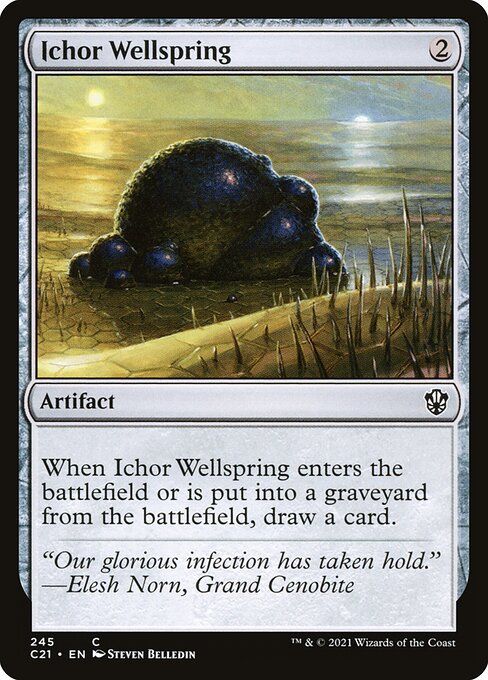
Ichor Wellspring

Ichor Wellspring card

The engine's centerpiece and the best two mana the deck spends. It draws a card when it enters and another when it goes from the battlefield to the graveyard, so it raises the artifact count while replacing itself twice over. That second trigger makes it the premier fodder in the deck: every sacrifice outlet gains a card when this is what pays the cost. Cast it early even with nothing else going on; both halves come back around.

Blood Fountain
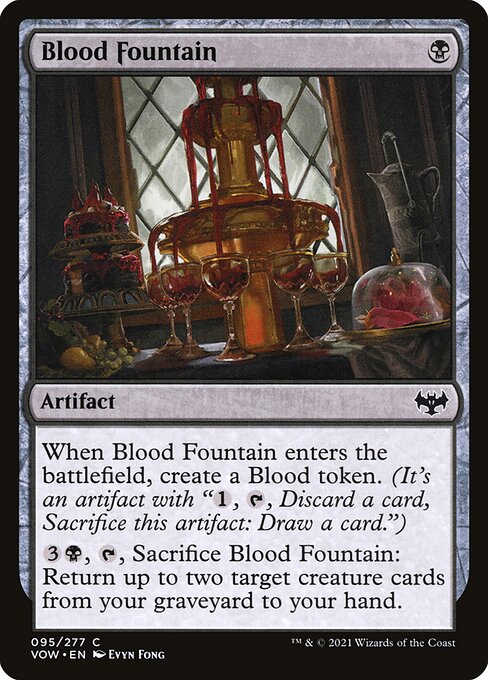
Blood Fountain card

One black mana buys two artifacts, counting the Blood token it creates when it enters, and nothing grows the count faster than that. The Blood token is a small luxury later: one mana, a tap, a discard, and its own sacrifice trade the worst card in your hand for a new one. The card's own ability is the deck's mana sink and recursion in one: four mana with a tap and its sacrifice return up to two creature cards from your graveyard to hand. While it sits in play, removal on your creatures is never a permanent answer.

Reckoner's Bargain
Reckoner's Bargain card

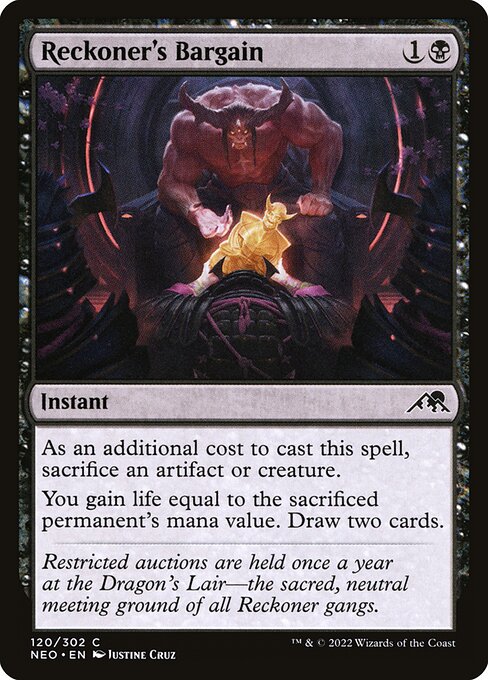
Instant-speed conversion: sacrifice an artifact or creature as part of the cost, draw two cards, and gain life equal to the sacrificed permanent's printed mana value. The fodder choice matters - a Blood token banks nothing while Myr Enforcer banks 7 - and Ichor Wellspring is the default because its death trigger deepens the exchange. Its other job is rescuing a creature from targeted removal.

Thoughtcast
Thoughtcast card

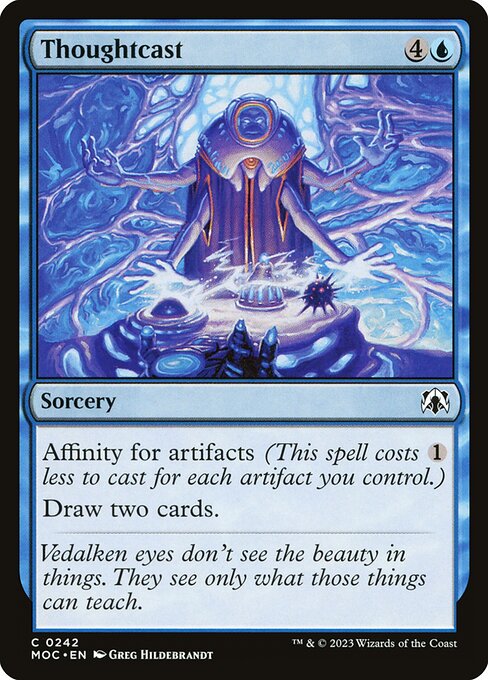
Printed at five mana and almost never cast for more than two. With a developed board it costs a single blue mana and draws two cards, which is the rate that lets the deck treat every threat as replaceable. Cast the turn's affinity creature first, since the new artifact discounts this too - the standard double-spell turn is threat first, then Thoughtcast. It is the card that makes the second wave automatic.

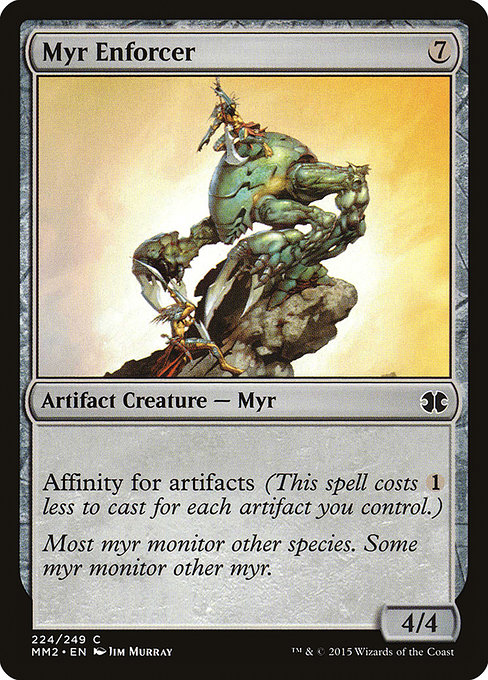
Myr Enforcer

Myr Enforcer card

The deck's signature card. Printed at seven mana, it lands on turn three for one mana in a normal draw and for nothing in a good one, and a 4/4 that early dominates the ground: it blocks nearly everything a fast start can present and forces the opponent to find real removal. It does not fly, though, so your own Krark-Clan Shaman deals it 1 damage per activation; its 4 toughness shrugs off up to three of them. It is also the premium Reckoner's Bargain sacrifice, banking 7 life whenever you need the cushion.

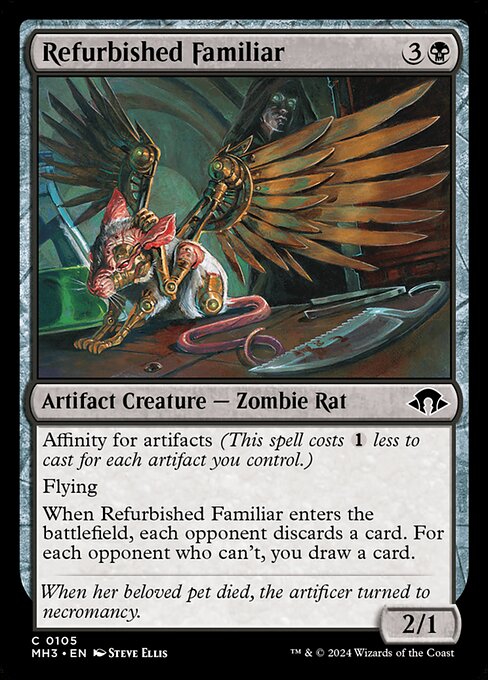
Refurbished Familiar

Refurbished Familiar card

Printed at four mana, usually cast for one black. You get a 2/1 flyer, and as it enters the opponent discards a card of their choice - if their hand is empty, you draw one instead - so it is never a plain body. It pressures the air, taxes the opponent's hand, and comes back later through Blood Fountain. The 1 toughness means it trades away cheaply, but a creature that already paid for itself on arrival is a fine thing to trade.

Utrom Monitor

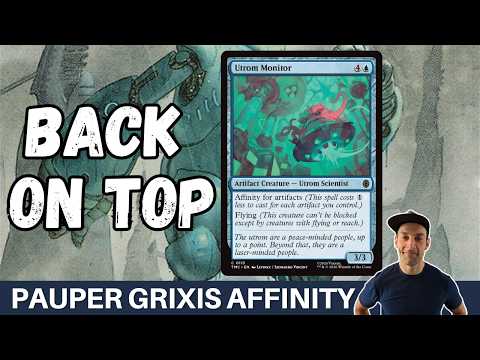
Utrom Monitor card

A five-mana card that routinely costs one blue, and the cleanest closer in the deck. It carries no trigger and needs no support: a 3/3 flyer simply ends games that Myr Enforcer stalls, attacking over boards that cannot block it. Alongside Refurbished Familiar it forms the flying clock the whole deck leans on. The ground can stall for turns; the flyers keep hitting.

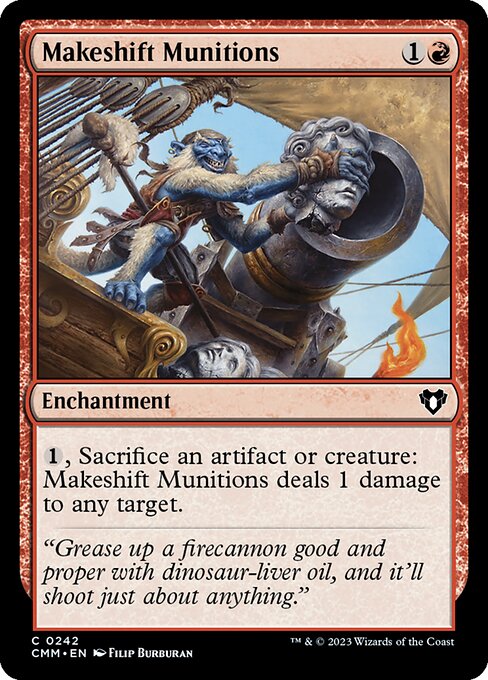
Makeshift Munitions

Makeshift Munitions card

The closer for stalled boards. It is an enchantment, not an artifact - it neither raises the count nor gets caught by anything aimed at artifacts - and for one mana plus a sacrificed artifact or creature it deals 1 damage anywhere at instant speed. The right fodder makes each shot free or better. A validated line: with Makeshift Munitions in play, two activations in one turn sacrifice Ichor Wellspring, which draws as it dies, and a spent Nihil Spellbomb, cashed for another card with one black mana - 2 damage to the opponent and two cards drawn along the way. It also picks off 1-toughness creatures and gives every spare artifact a job once the game goes long.

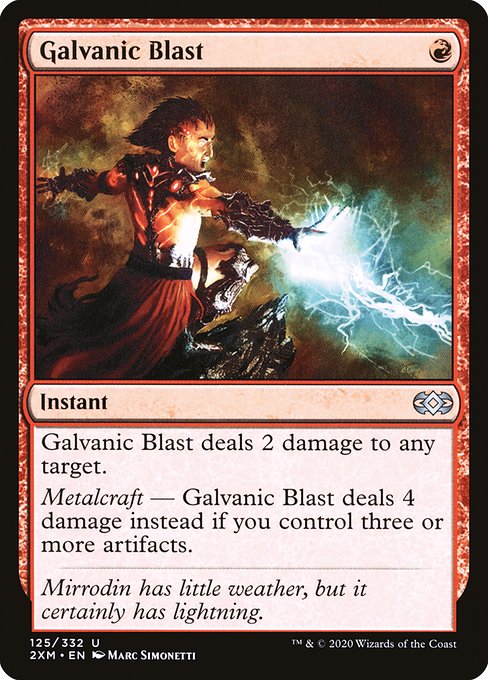
Galvanic Blast

Galvanic Blast card

The removal spell. One red mana deals 2 damage at instant speed, and with three or more artifacts in play - usually true by the second or third turn here - it deals 4 instead, enough to kill anything up to 4 toughness. Spend it on the early attackers that punish your tapped lands, and remember it aims at players too: the final 4 damage often arrives this way. With Krark-Clan Shaman covering wide boards of small creatures, save the Blast for the single biggest problem.

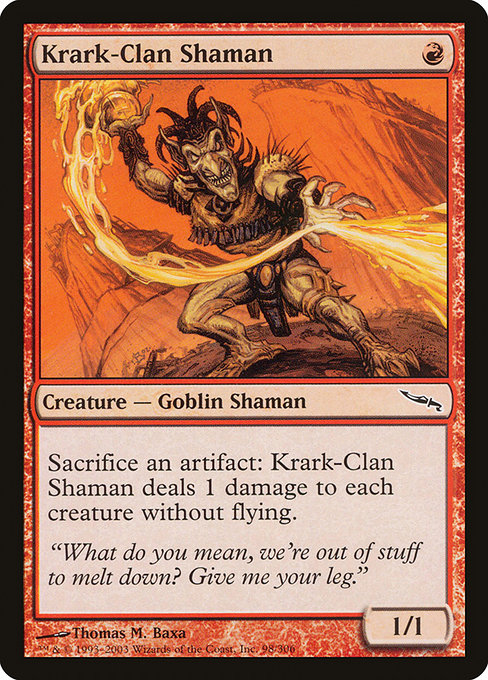
Krark-Clan Shaman

Krark-Clan Shaman card

The board sweep. Sacrificing an artifact - no mana required - deals 1 damage to each creature without flying, yours included, and you can do it as many times as you have artifacts to feed it. The sweep is nearly one-sided: Refurbished Familiar and Utrom Monitor fly over it (as do any opposing flyers), and Myr Enforcer has toughness to spare, so an opponent who commits several low-toughness ground creatures invites a blowout. It is itself a 1/1 without flying, so plan the whole sweep before you start.

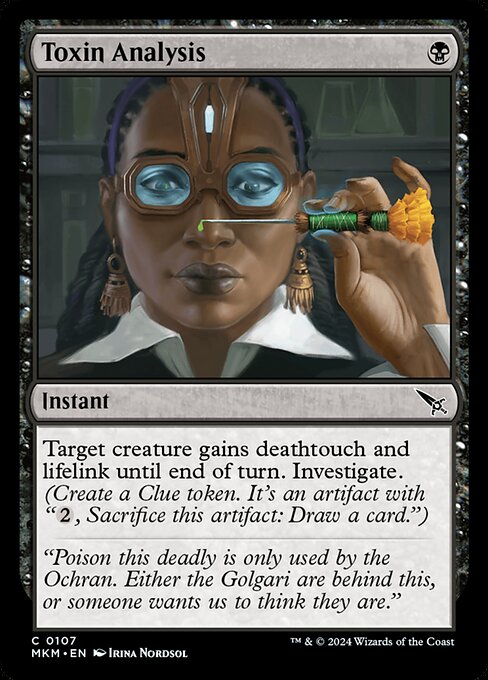
Toxin Analysis

Toxin Analysis card

One black mana of combat interaction plus a Clue. At instant speed one of your creatures gains deathtouch and lifelink for the turn, so any body kills each creature it damages, and the damage it deals comes back as life. Use it to make blocking Myr Enforcer a disaster, or to let a small blocker eat the largest attacker while banking the life. The Clue token raises the artifact count immediately and cashes in for a card later at two mana plus its sacrifice. When neither player is attacking or blocking, only the Clue half is live - the one spot where it underperforms.

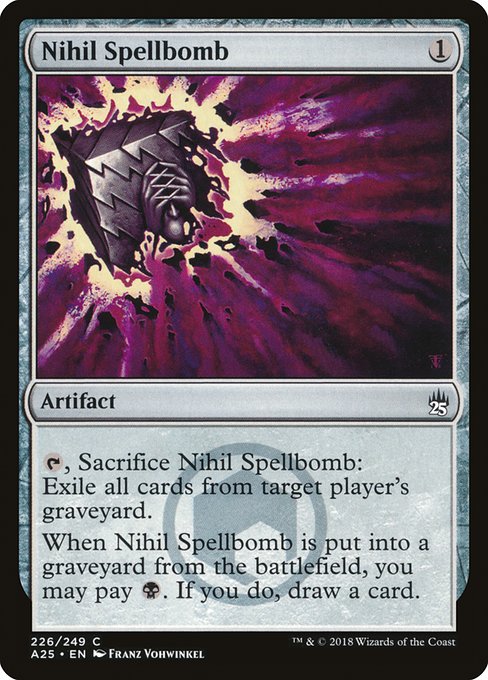
Nihil Spellbomb

Nihil Spellbomb card

A one-mana artifact with two jobs. Tapping and sacrificing it - no mana in the cost - exiles a player's entire graveyard, the deck's answer to graveyard-based strategies; hold it until the exile actually stings rather than cracking it on sight. Everywhere else it is a cheap artifact that raises the count and still converts into a card: when it goes to the graveyard from the battlefield, paying one black mana draws you a card. Sacrifice it only with black open, and against decks that never use their graveyard, feeding it to an outlet is its whole purpose.

Role Assignment

Grixis Affinity is a midrange deck with a deep card-advantage engine, a tempo-neutral start, and medium inevitability. It out-resources fair decks in a long game, but it does not automatically win the longest game, and its clock - flyers closing around turn six - is unhurried. Those traits fix the roles below, and they fix the terrain too: nearly every matchup is contested on the same four axes. Can removal attack the artifact count profitably, or does it trade down against pieces that draw a card as they die? How much damage do the tapped-land turns concede? Can one-for-one answers keep pace with the draws and Blood Fountain rebuys? And who owns the air while ground creatures play under the threat of Krark-Clan Shaman?

Vs. Aggro. You are the control. The tapped lands concede the first turns, the clock cannot win a pure race, and the whole matchup lives on the damage-during-setup axis - so do not fight over it. Trade early, spend Galvanic Blast on the attacker that hurts most, wall the ground with Myr Enforcer, and bank life with Reckoner's Bargain and Toxin Analysis. The role-defining play is the stacked Krark-Clan Shaman sweep: several activations at once clear a wide board in a single exchange while your flyers survive untouched. Once the board is stabilized, your draws bury them.

Vs. Midrange. You are the control first and the beatdown later, because attrition favors you. Spot removal trades down against artifacts that replace themselves, and up to two of the creatures that do get answered, Blood Fountain can return - most of those exchanges leave you even or a card ahead. Once the answers thin out, flip roles and push the air-war axis: Refurbished Familiar and Utrom Monitor attack over a ground that cannot profitably cross into Myr Enforcer. The defining play is rebuying a killed threat with Blood Fountain and redeploying it at a discount - the exchange that proves the resource war is unwinnable for the other side.

Vs. Control. You are the beatdown, and an unusually durable one. Spot removal is exactly what the artifact count blanks: cheap answers trade down against artifacts that draw on the way out, so the first axis is yours by default, and your draws keep threats flowing faster than one-for-ones can answer them. The real risks are a sweeper, mass artifact removal, and counterspells on the key threat, so deploy one discounted threat at a time with a rebuilt wave behind it rather than emptying the hand at once. Refurbished Familiar is the role in one card: a flyer that lands for as little as one mana with three artifacts already out, forcing a discard on arrival, pressure and disruption together. Your inevitability is only medium, though - against a dedicated late game, keep a clock going rather than settling into a pure resource war.

Vs. Combo. You are the beatdown by necessity - a combo opponent mostly ignores your board - but a turn-six clock is slow for the role, so the missing speed comes from disruption and sequencing. Refurbished Familiar forces a discard the turn it lands, and Nihil Spellbomb answers any engine that relies on the graveyard: cast it early for the count, but crack it only when the graveyard is about to matter, at instant speed in response if need be. Prioritize deploying threats over holding up answers you mostly do not have, and point every spare burst of direct damage - Galvanic Blast, Makeshift Munitions - at the opponent to shave the last turn off your clock.

Sequencing Heuristics

  1. Play every artifact you can before casting an affinity spell, and hold sacrifice effects until after it is cast. Affinity checks the artifact count as the spell's cost is locked in, and everything counts: artifact lands, Blood tokens, Clue tokens. Each artifact that hits play first shaves one mana off the spell; each artifact you sacrifice first puts one back on. A validated line shows the stakes. Turn one, Vault of Whispers into Blood Fountain makes three artifacts with the token; turn two, Great Furnace into Ichor Wellspring makes five and draws a card. On turn three, play Drossforge Bridge first for six - a tapped artifact still counts - then cast Nihil Spellbomb for seven, and Myr Enforcer is free with Great Furnace still untapped. Cast Myr Enforcer before Nihil Spellbomb and it costs one mana; cast it before the land drop and it costs two. Misordering the same cards routinely wastes one to three mana a turn.
  2. Decide how big a Krark-Clan Shaman sweep you need, then put every activation on the stack before the first one resolves. Krark-Clan Shaman is itself a 1-toughness creature without flying, so the first activation that resolves kills it and no further activations are possible - but activations already announced still resolve after it dies. If the board needs 2 or 3 damage, sacrifice two or three artifacts up front and let the whole stack resolve. Refurbished Familiar and Utrom Monitor fly over every activation; Myr Enforcer does not, so count its 4 toughness into the total before you go past three.
  3. When removal targets a big affinity creature - or you need life in a race - cash the creature to Reckoner's Bargain in response. The life gained equals the sacrificed permanent's printed mana value, not the discounted price you paid, so Myr Enforcer banks 7 life plus two cards while a Blood or Clue token banks zero. Because the sacrifice is part of the cost, the creature is already gone when the removal spell tries to resolve: it has no target left and does nothing. You turn a clean answer into two cards and 7 life.
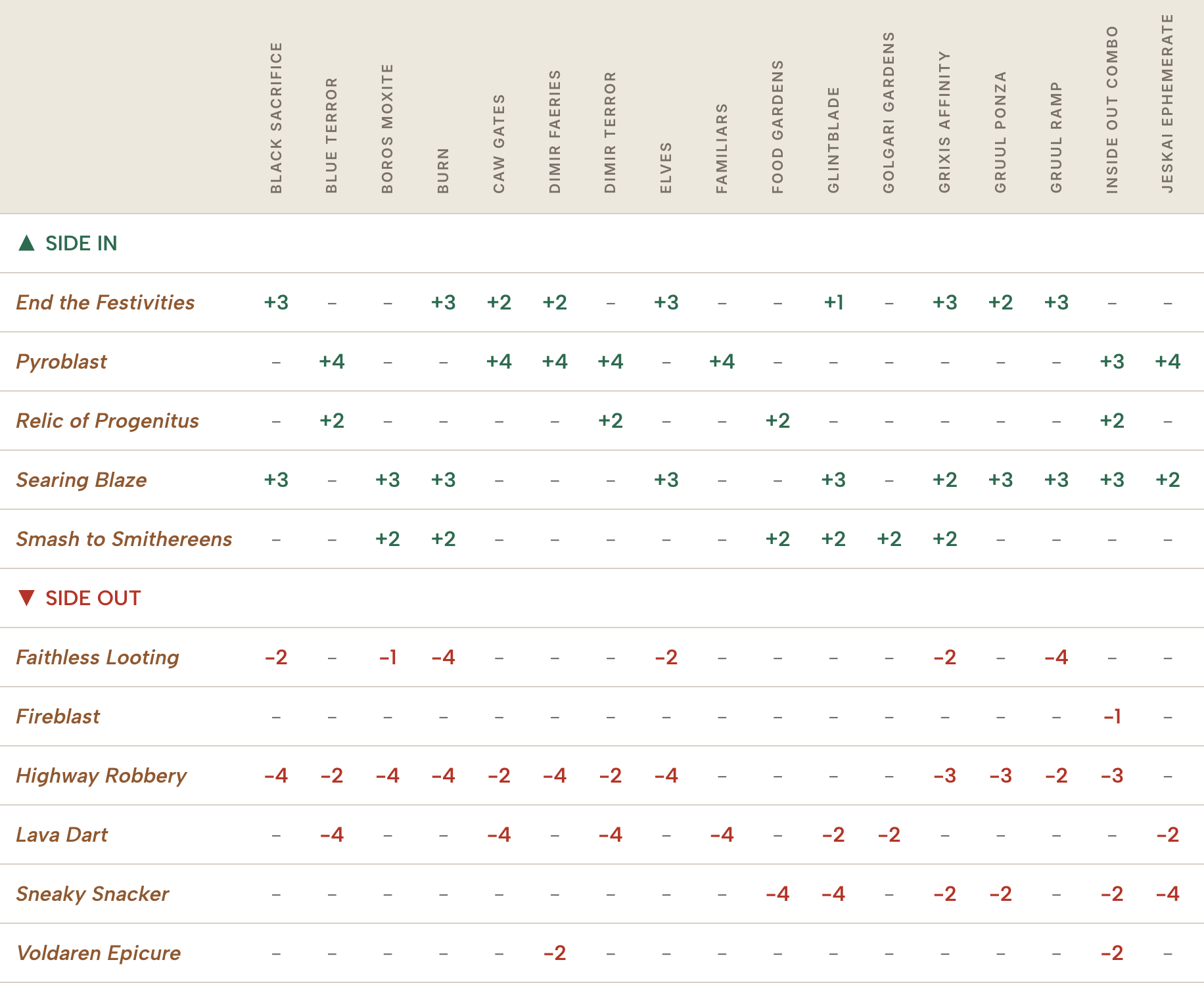
  4. Pay sacrifice costs with artifacts that reward you for dying: Ichor Wellspring first, then a spent Nihil Spellbomb with a black source still untapped. Ichor Wellspring draws again on its way out, and Nihil Spellbomb draws if you can pay one black mana as its trigger resolves, so the right fodder makes every outlet gain you a card. Feeding a Blood token or a fresh artifact instead skips the payoff and lowers the artifact count for nothing. The Makeshift Munitions line in The Cards shows the payoff when the fodder is chosen well.