







Introduction
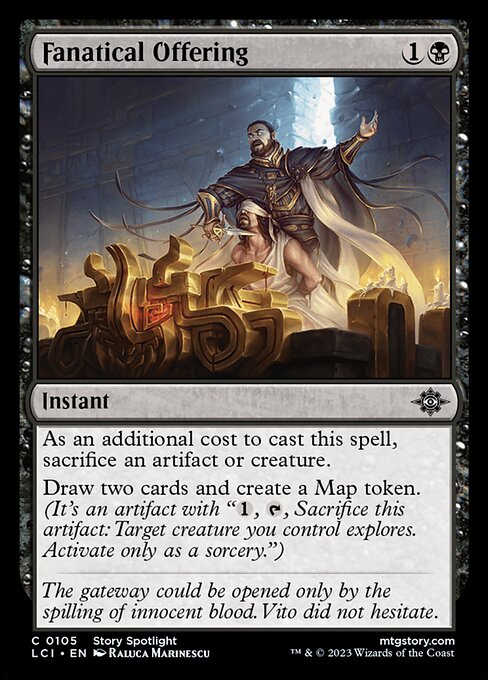
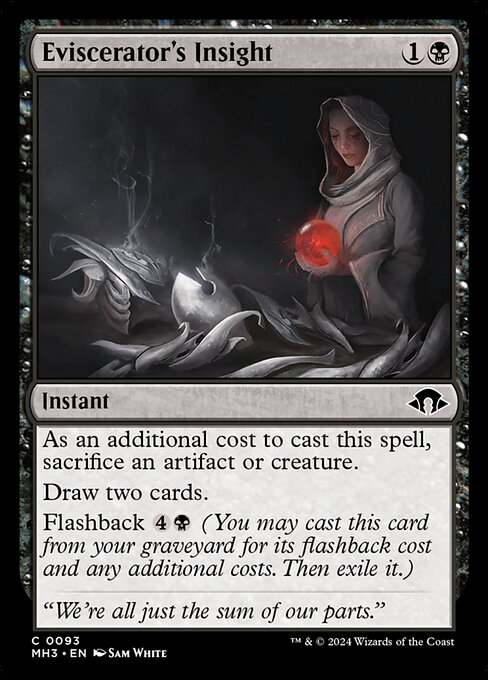
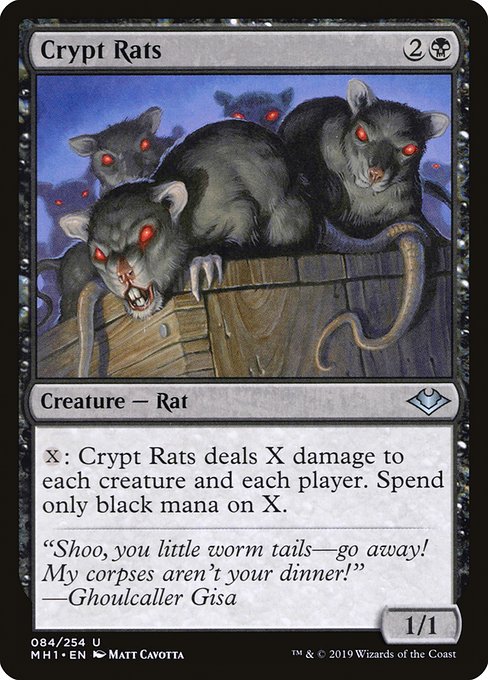
Golgari Gardens is a black-green deck that answers creatures one for one with cheap removal and forced sacrifices, feeds its spare artifacts and tokens to Fanatical Offering and Eviscerator's Insight for a steady supply of fresh cards, and closes the game late with Troll of Khazad-dûm or a big Crypt Rats activation. It occupies a modest 2.1% of the field, a share that undersells its recent results: __Noob__ won the September 14 Pauper Challenge with it and placed fifth in the September 17 Challenge, after a Top 4 finish on September 5, and the deck also won a paper event in Genoa on September 13.
The deck beats creature decks that fight on the board, where its removal and edicts keep trading until the card engine pulls ahead, and the slower interactive decks that try to grind it out and end up out-drawn. It is favored against Mono Red Madness, Mono Blue Faeries, Spy Combo, Elves, Jund Wildfire, White Aggro, Familiars, and Ephemerate Tron, and slightly favored against Blue Terror and Bogles.
It struggles against ramp decks that resolve big threats faster than one-for-one removal can keep pace with, and against storm decks that ignore the board entirely and leave most of that removal with nothing to hit. It is slightly unfavored against Monster Tron, Mono Red Rally, Dimir Faeries, Black Sacrifice, and Ruby Storm, and unfavored against Gruul Ponza, Naya Gates, Gruul Ramp, and Cycle Storm.
General Strategy
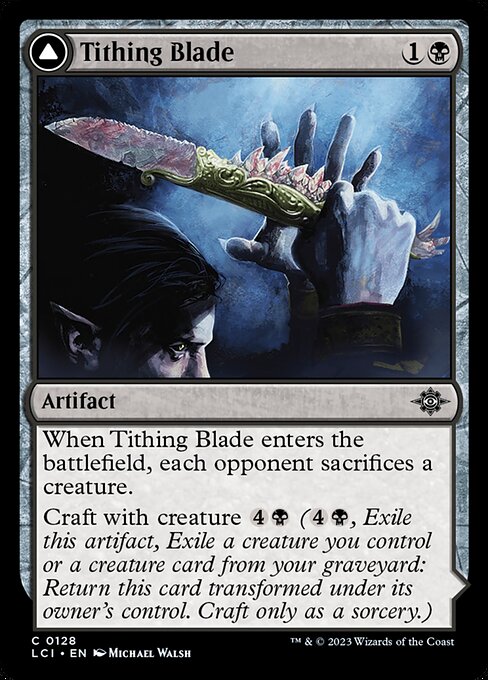
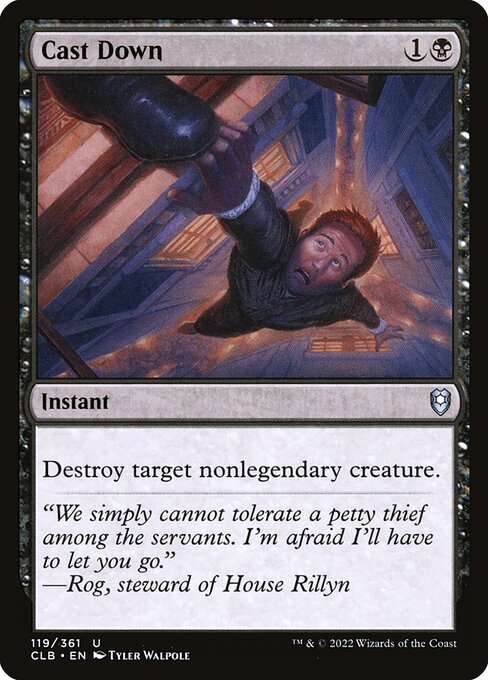
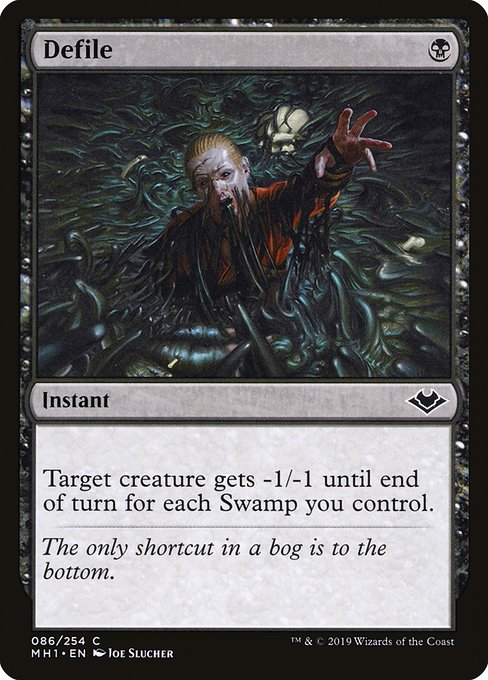
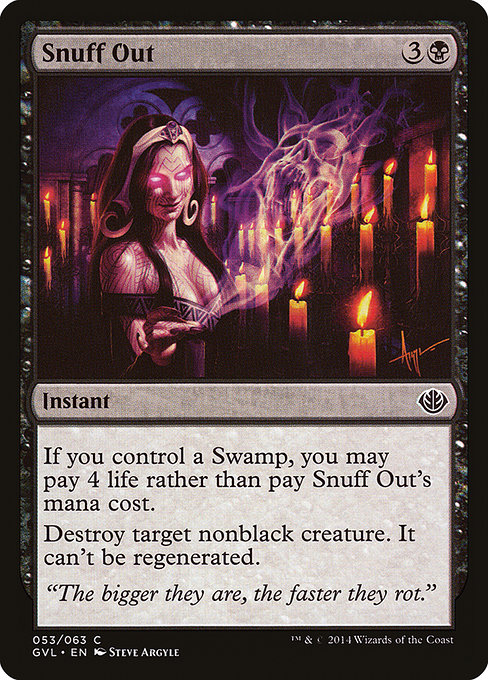
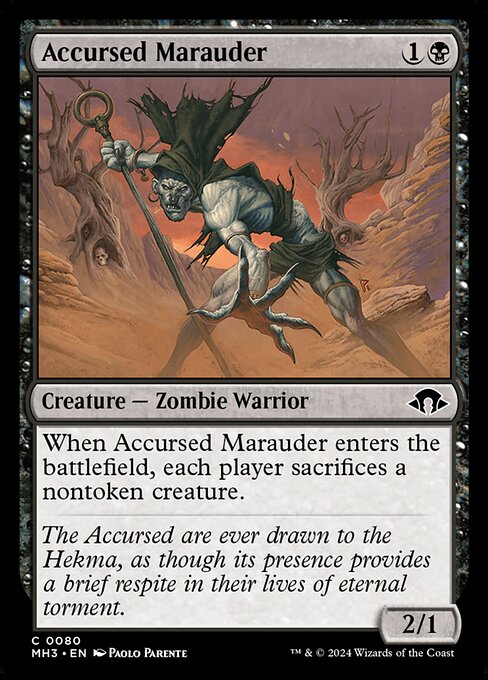
Golgari Gardens wants every exchange to come out in its favor and the game to run long. Cheap black removal such as Cast Down and Defile, together with the forced sacrifices of Tithing Blade and Accursed Marauder, answers whatever creatures the opponent commits to the board, while Khalni Garden, Ichor Wellspring, and Lembas put permanents into play that have already paid for themselves and are waiting to be sacrificed. The single most important thing the pilot does is keep feeding those permanents to Fanatical Offering and Eviscerator's Insight, so that each removal spell traded away is replaced by more cards and the opponent runs out of threats before you run out of answers. Winning comes afterwards, with Troll of Khazad-dûm attacking into a board that cannot gang up on it, or a Crypt Rats activation that clears the last points once the board is empty.
The engine is a set of cheap permanents and two sacrifice-cost draw spells. Ichor Wellspring draws a card when it enters and again when it leaves the battlefield for the graveyard, Lembas scries and draws on arrival, and Khalni Garden leaves a Plant token behind that costs nothing to give up. Fanatical Offering and Eviscerator's Insight each require sacrificing an artifact or creature and draw two cards, and Offering adds a Map token on top. Because the fodder has already replaced itself, every one of these spells converts a spare permanent into two fresh cards without ever putting you down on resources, and the Map from Offering becomes the fodder for the next one.
A game runs in three phases. The setup turns are about lands and cheap artifacts: taplands like Khalni Garden go down early, and follow, and spare copies of are swampcycled to guarantee the land drops, all while cheap removal keeps the opponent's board small. The payoff phase begins once there is fodder on the table: and start cashing the artifacts in, and from then on you are drawing two or three cards for every one the opponent draws. The close comes when the opponent has nothing left to trade with: and win through combat over a few big swings, and supplies a burst of damage that finishes the job when combat alone is not quite enough.
The Cards
Khalni Garden
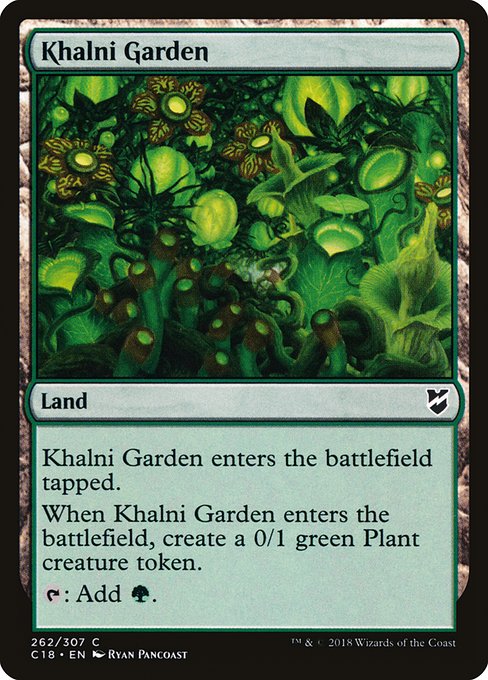
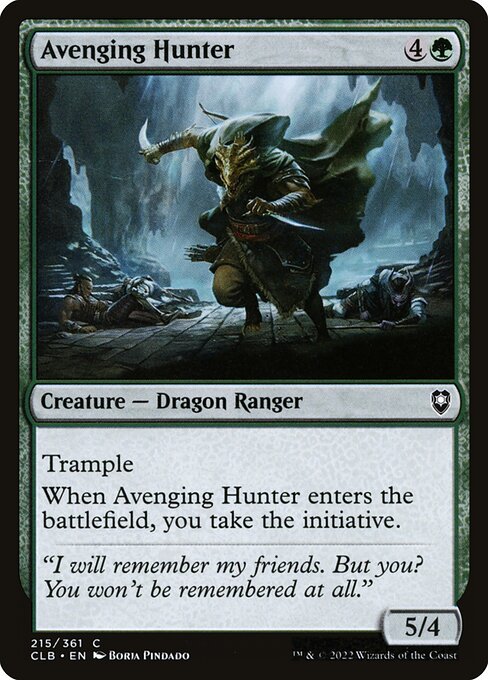
The land enters tapped and leaves a 0/1 Plant behind, which is the cheapest sacrifice fodder in the deck and the reason a hand with no artifact can still start the draw engine on its own. It is also one of only two green sources, so it is usually what casts Avenging Hunter. A typical opener shows how much one Plant is worth: Khalni Garden on the first turn, a Swamp on the second, pass with Cast Down mana open, and at the end of the opponent's turn cast Fanatical Offering sacrificing the Plant for two cards and a Map. The next turn plays a third land and repeats the pattern, holding Cast Down through the opponent's turn and casting Eviscerator's Insight at their end step with the Map as the sacrifice. That is four fresh cards over two turns with removal mana available the whole time, and the Insight now sits in the graveyard waiting to be flashed back.
Ichor Wellspring
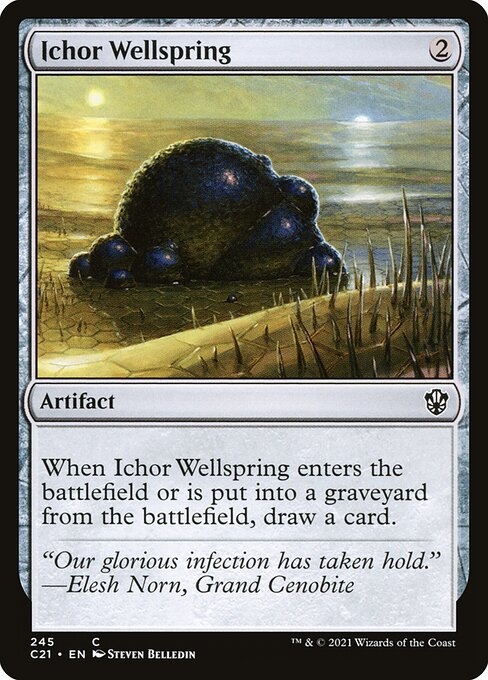
Two mana for a card when it enters and another when it goes from the battlefield to the graveyard, which makes it the artifact every sacrifice spell wants to eat: Fanatical Offering or Eviscerator's Insight sacrificing a Wellspring is three cards for one spell. Cast it early even when nothing else is going on, since it replaces itself on arrival and only gains value by sitting on the battlefield until a draw spell needs it.
Lembas
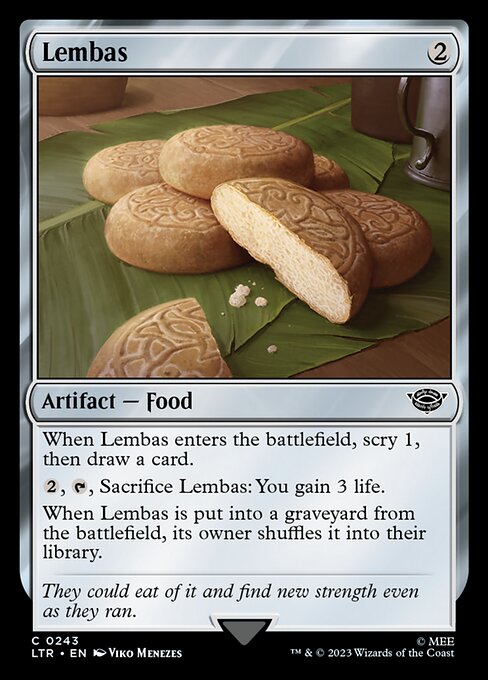
It scries and then draws when it enters, so it smooths the next draw as well as replacing itself, and later it turns into lifegain when a race gets tight: two mana, a tap, and the sacrifice gains 3 life. When it goes to the graveyard from the battlefield it shuffles back into the library, so sacrificing it to a draw spell never costs a card, though it also never adds one the way does. It is a fine mana sink in a stalled game and a way to keep your life total ahead of the opponent's for the finish.
Role Assignment
Golgari Gardens is a control deck through and through: interactive rather than linear, tempo-negative because its lands often enter tapped and most of its spells trade one for one or draw cards instead of pressuring, and high on inevitability because the draw engine, the flashback on Eviscerator's Insight, and the crafted Consuming Sepulcher mean the long game belongs to it. The interaction suite is deep but narrow: creature removal, edicts, a symmetric sweeper in Crypt Rats, and graveyard hate, with nothing in the maindeck for artifacts or enchantments. Every matchup is fought on some mix of five axes: whether the opponent can race the engine, how their creatures line up against black removal and -1/-1 effects and edicts, what noncreature permanents they resolve, whose graveyard matters more, and where the life totals sit when Crypt Rats or the Sepulcher drain comes online.
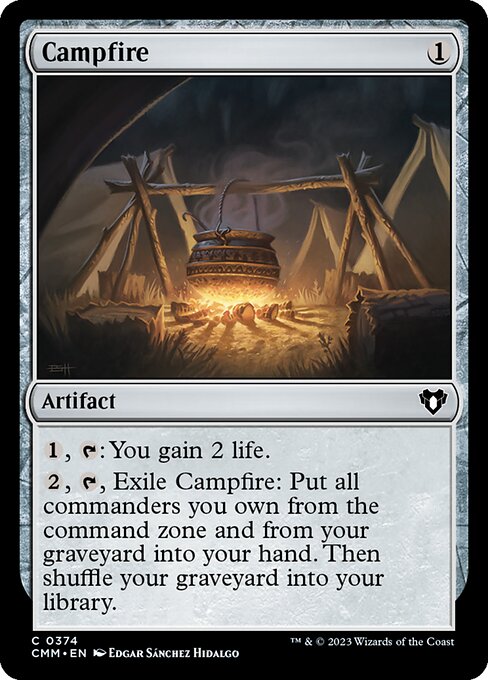
Vs. Aggro. Against aggro you are the control deck without exception, and the whole game is the race between their clock and your engine. Spend the early turns on removal rather than card draw; a Fanatical Offering cast into an unanswered board is a turn you did not have. The play that defines the role is holding Cast Down mana through the opponent's turn and only casting the draw spell at their end step when nothing needed killing, while Campfire and Lembas keep your life total high enough that a Crypt Rats activation clears their board without endangering you. Once they overcommit into the Rats, the roles flip and the game is yours.
Vs. Midrange. Against midrange you are still the control deck, but the fight is over card advantage rather than tempo. Their threats tend to be few and large, which is where Tithing Blade and Accursed Marauder trade up, and Cast Down handles the rest one for one. The play that shows the role is the end-step Eviscerator's Insight off an , three cards for one spell, repeated with flashback later: you are not trying to win quickly, you are trying to make every trade cost them more than it costs you until the crafted or a finishes a board they can no longer contest.
Play Patterns
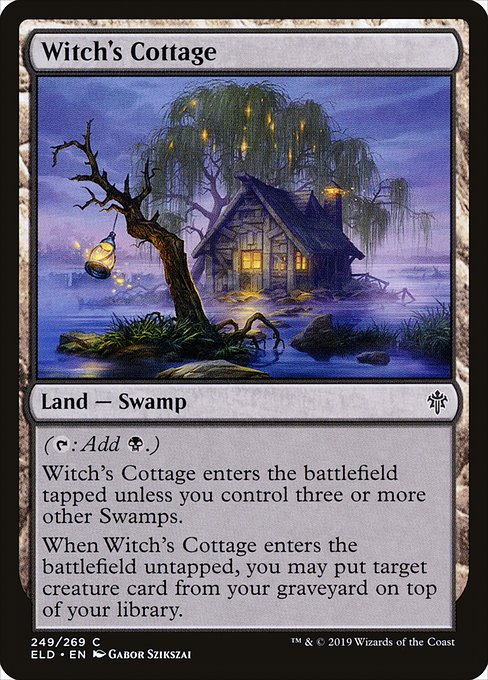
Swampcycle spare copies of Troll of Khazad-dûm early instead of holding them as threats. For one mana the Troll becomes the land drop this tapland-heavy deck needs most, and the body is not lost: Witch's Cottage entering untapped puts a creature card from your graveyard back on top of your library, and because the Cottage carries the Swamp type the swampcycle can even fetch it.
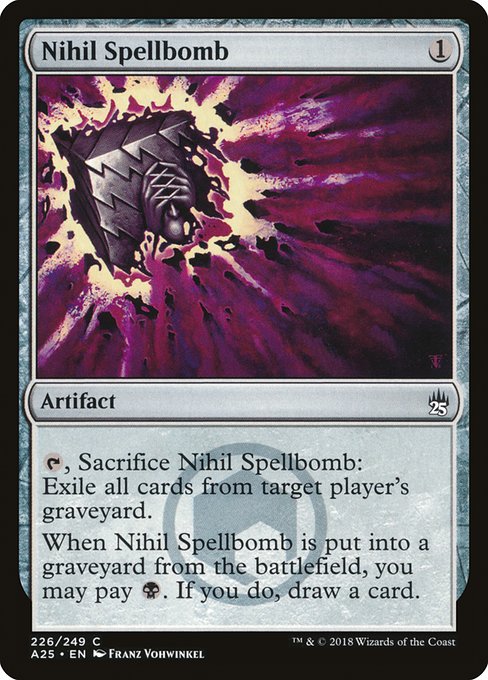
Feed Ichor Wellspring to your sacrifice costs before any other permanent. Once it has entered, the Wellspring's only remaining value is the extra card it draws when it goes from the battlefield to the graveyard, so sacrificing it costs nothing and gains a card. Every other candidate gives something up: Lembas only shuffles itself back with no draw, Nihil Spellbomb spends the graveyard-hate bullet, and the Plant and Saproling tokens may be needed as blockers.
Before a lethal Crypt Rats activation, get your life total above the opponent's and count only your black mana. The activation deals its damage to each player, you included, and X can be paid only with black mana, so Khalni Garden adds nothing to it no matter how many lands you have. The turns before the kill are for banking life with Campfire and Lembas; a Rats activation that leaves you at a lower total than the opponent is a way to lose the game, not win it.
When holding Defile, play lands with the actual Swamp type first. Defile counts Swamps, not black sources: basic Swamp, Haunted Mire, and Witch's Cottage grow it, while Khalni Garden and Bojuka Bog never do. Two land drops that look identical from the outside decide whether the removal spell kills a 3-toughness creature on the turn it matters.