





Introduction
Jund Wildfire is a black-red-green artifact deck built around a trick no other deck in Pauper gets to play: it points Cleansing Wildfire, a land-destruction spell, at its own indestructible Drossforge Bridge - the bridge survives, a basic land arrives, and a card gets drawn. A two-mana spell that ramps you, fixes your colors, and costs no cards is the deck in a single image. Everything else follows the same rule: cheap artifacts that replace themselves on the way in or the way out, so every trade the opponent makes leaves you a card ahead.
That patience shapes the matchup spread. The deck is at its best against slow, interactive opponents, where every answered threat has already paid for itself: favored against Blue Terror - at 10.5%, a large slice of the field - and against Dimir Faeries and Dimir Terror, and slightly favored against Monster Tron. Grixis Affinity and Elves sit close to even. The hard seats are speed and bigger value engines: unfavored against Mono Red Madness, alone 8.6% of the metagame, and against the dedicated value decks Jeskai Ephemerate and Golgari Gardens.
Games with this deck have a distinctive arc: the extra cards pile up quietly until the opponent finds that every threat they answered has already been replaced. If you enjoy winning long games on card advantage rather than speed, it is hard to do better in Pauper - a steady 5.6% of the field agrees.
General Strategy
Jund Wildfire wins by exchanging cards at a profit until the opponent has nothing left, then attacking through the wreckage. It is not a fast deck and does not want to be one: left alone it kills somewhere around turn eight, and that is fine, because almost every card in the list either replaces itself or trades for something on the way out. Your job as the pilot is to keep the engine fed - hit every land drop, keep artifacts arriving, convert them into cards - while spending as little as possible to contain what the opponent is doing. You are not racing. You are outlasting.
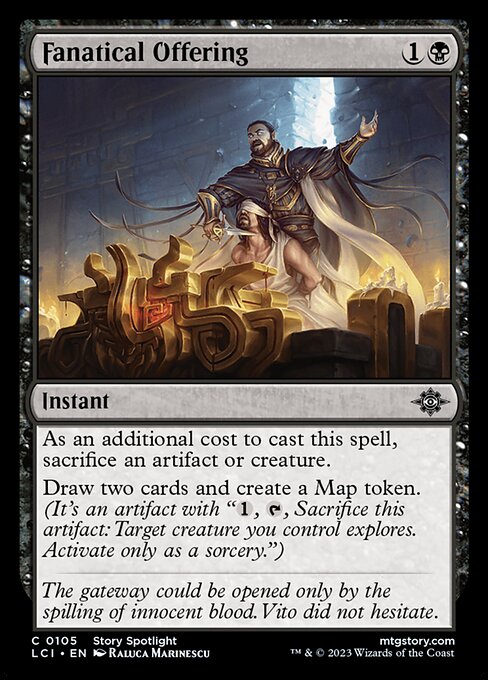
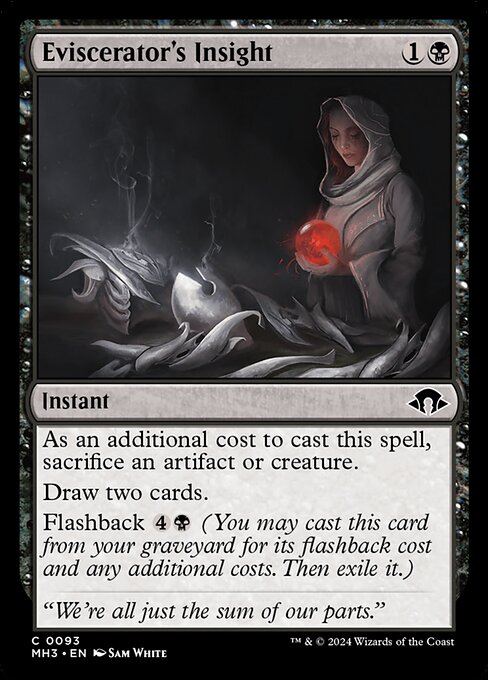
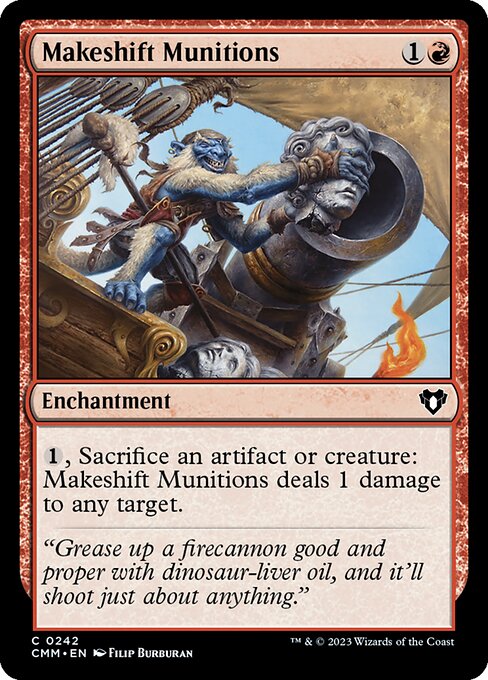
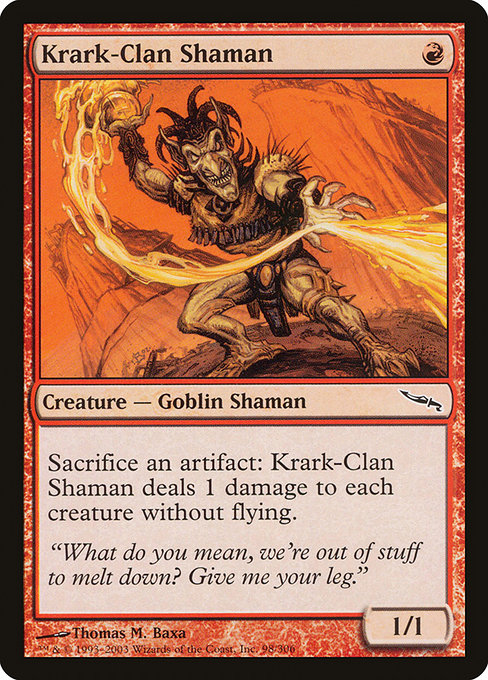
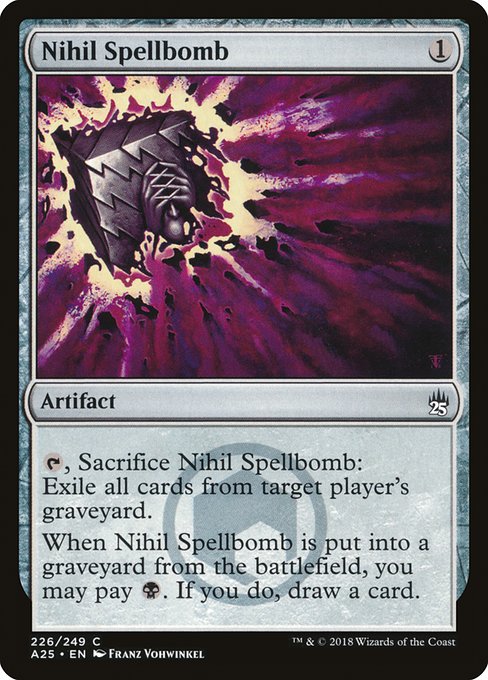
The engine has two halves. The first is the land package: Drossforge Bridge and Slagwoods Bridge are indestructible, so Cleansing Wildfire aimed at one of them destroys nothing - you still search up a basic land, which arrives tapped, and draw a card. That makes the spell a two-mana ramp effect that fixes your colors and costs no cards. The second half is the artifact loop: Ichor Wellspring draws a card when it enters and another when it dies, and Nihil Spellbomb replaces itself on death as long as black mana is open, so every sacrifice outlet in the deck - Fanatical Offering, Eviscerator's Insight, Makeshift Munitions, Krark-Clan Shaman - gets an extra card stapled on whenever it eats one of them. String those together and the deck simply draws more than the opponent, turn after turn.
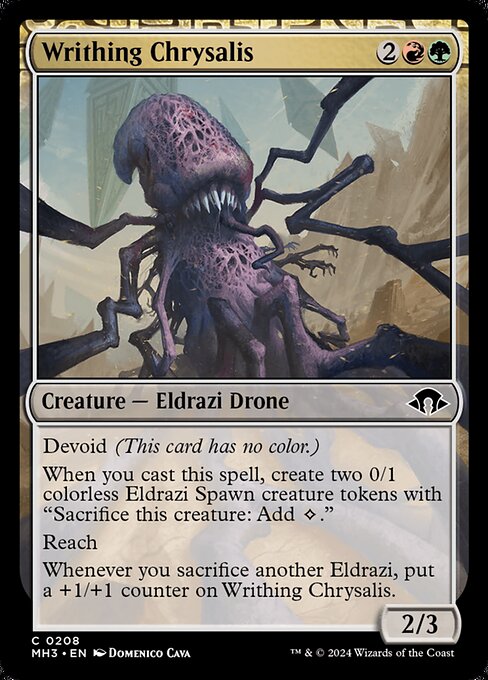
An uncontested start shows the plan working. Turn 1, Drossforge Bridge enters tapped. Turn 2, play a Swamp and cast Cleansing Wildfire at that same bridge: the bridge survives, a basic comes in tapped, and you draw. Turn 3, Slagwoods Bridge plus Ichor Wellspring, drawing again. Turn 4, Writhing Chrysalis arrives with two 0/1 Eldrazi Spawn tokens in tow. Turn 5, Fanatical Offering sacrifices the Ichor Wellspring for a three-card turn plus a Map token, and Writhing Chrysalis starts attacking. Five turns in you have four lands in play, drawn several extra cards, and built a board that improves every time something dies.
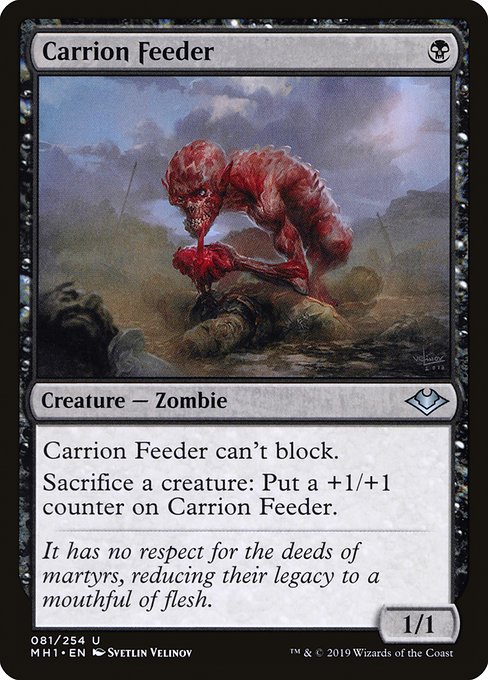
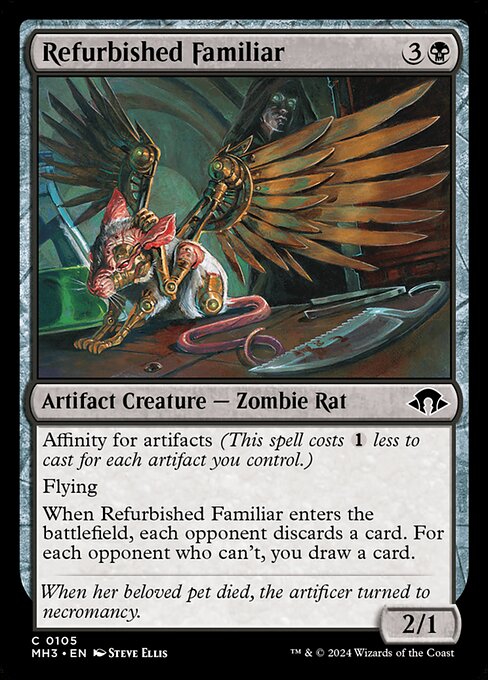
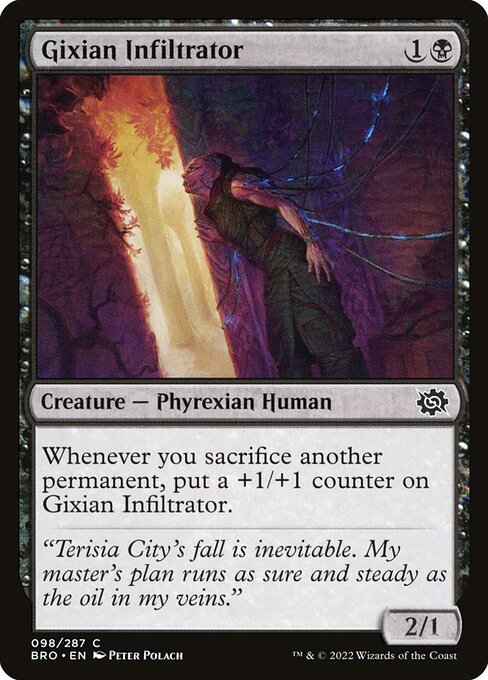
The kill itself is unglamorous. Writhing Chrysalis starts as a 2/3 and grows a counter at a time as you sacrifice its Eldrazi Spawn, Refurbished Familiar chips in from the air, and Gixian Infiltrator turns the sacrifice count into combat damage. When combat stalls anyway, Makeshift Munitions finishes from range by converting spare artifacts and Spawn into direct damage. None of these wins quickly. Backed by a hand that never empties, they win eventually.
When the threats do get answered, the deck barely notices. Most of what dies already paid for itself, since the artifacts draw a card on the way out, and the engine keeps producing: Eviscerator's Insight returns from the graveyard for a second draw-two, fresh artifacts like Lembas keep replacing themselves as they arrive, and Nihil Spellbomb strands any opponent trying to rebuild out of their own graveyard. The backup plan is the main plan with more patience: keep trading, keep drawing, and present a new threat every few turns until the answers run out.
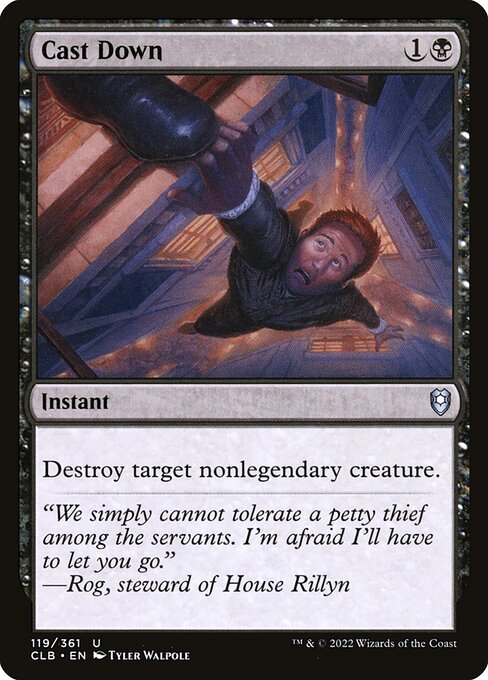
Two things actually beat you, and both are worth naming now. The first is speed: the deck's bodies are small and its kill is slow, so a fast aggressive start can end the game before the engine matters - under pressure, spend the early turns on Cast Down and blockers rather than card advantage, because cards in hand do not block. The second is stranded draw spells: Fanatical Offering and Eviscerator's Insight need an artifact or creature on the battlefield to sacrifice, so an empty board turns your best cards into blanks. Deploy an Ichor Wellspring ahead of the spells that want to eat it.
The Cards
Cleansing Wildfire
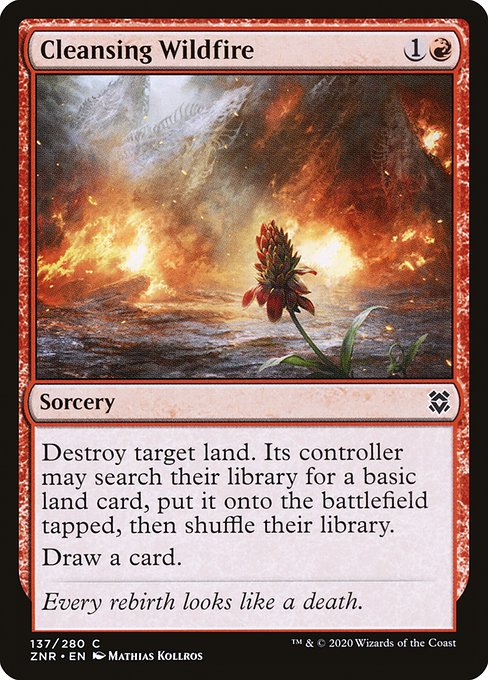
The deck's signature card and the reason the mana base looks the way it does. Pointed at one of your own bridges, it is a two-mana play that puts a basic onto the battlefield, fixes whichever color your hand is missing, and draws a card - all without actually losing the land, since the bridges cannot be destroyed. Cast it early and often; it is how a three-color deck full of tapped lands still hits its drops on time. The targeting rule is simple: your own land, not theirs.
Drossforge Bridge
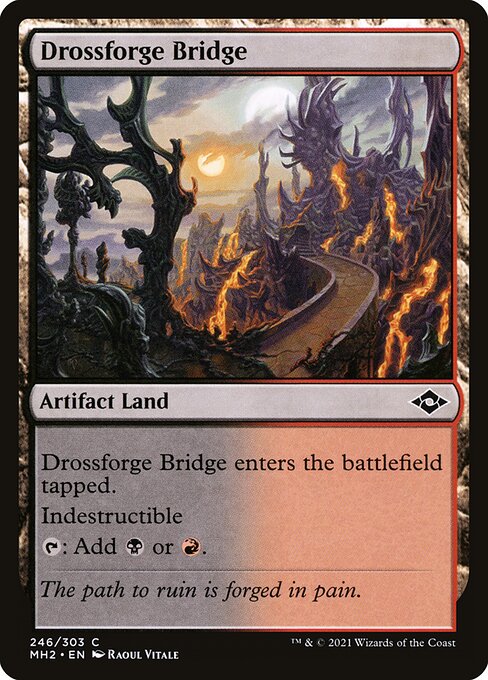
The black-red half of the eight indestructible bridges Cleansing Wildfire wants to hit. Its artifact type works overtime: it counts toward Refurbished Familiar's affinity, and in a pinch it can be sacrificed to Krark-Clan Shaman or Makeshift Munitions like any other artifact. The real cost is on the front end: it enters tapped, which is where most of the deck's slow starts come from, so plan your first two turns around it.
Slagwoods Bridge
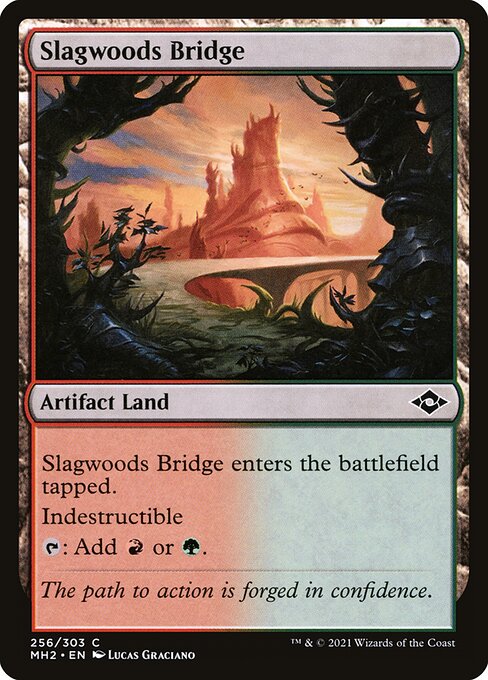
The red-green bridge and your most reliable green source: it is what lets a turn-4 Writhing Chrysalis happen on schedule. Everything said about Drossforge Bridge applies here too - indestructible Cleansing Wildfire target, affinity count, emergency sacrifice fodder - so which bridge you play first is purely a question of which colors the hand needs.
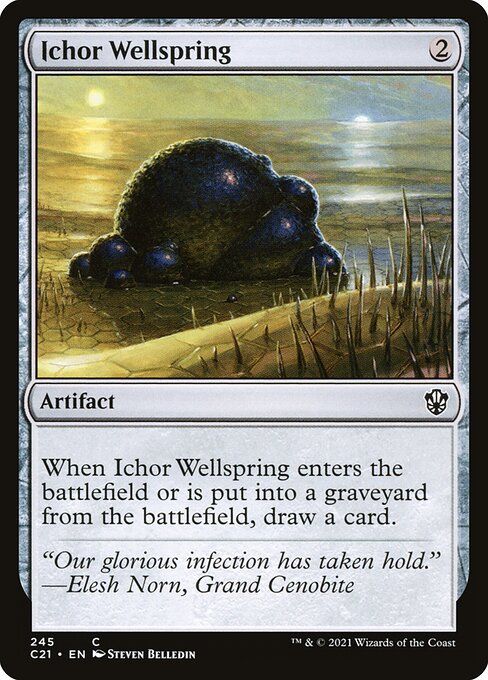
Ichor Wellspring
Role Assignment
Two facts fix our role in nearly every matchup: the clock is slow - an uncontested kill lands around turn eight - and our inevitability is real, because the engine out-draws almost any fair deck given time. So the question in each pairing is whether the opponent can kill us before the card advantage takes over. When they can, we play defense. When they cannot, we are in no hurry.
Vs. Aggro. We are the control, with no room for debate: any dedicated aggro deck's clock beats ours, so the early turns go to interaction and bodies, not value. This is the one context where Writhing Chrysalis's Spawn are blockers first and fodder second, where Cast Down gets spent on curve rather than saved, and where Krark-Clan Shaman plus a couple of spare artifacts is the play you build toward - a stacked sweep that clears a wide board of small attackers, and it is symmetric: each activation hits every creature without flying, so the 0/1 Spawn you were blocking with and the 1/1 Shaman itself die alongside their team. The life total is a resource on this axis but not a deep one, since the maindeck has almost no dedicated lifegain: stabilize the board before the damage adds up, and once it is contained, the grind wins on its own.
Vs. Midrange. The grind is home turf, so we default to the control role: our two-for-ones are denser than almost anyone's, which means every one-for-one exchange - creature for creature, removal for threat - moves the game toward a state where we have cards and they do not. Trade cheerfully, keep Cast Down for the one creature that genuinely threatens us, and let the sac-draw spells rebuild after every exchange. The role flips only when their engine out-draws ours or their artifact hate strips the loop; then we become the beatdown and push damage while the engine limps. Be honest about which axis the game is actually on - resources or pressure - and play to it.
Vs. Control. We are the beatdown, but a patient one. Nearly every threat we present has already paid for itself, which blunts their answers: Writhing Chrysalis leaves two Spawn behind even when the spell is countered, Refurbished Familiar takes a card from their hand the moment it lands, and the bodies a sweeper catches had already paid us on the way in. So attack with volume, not haste: one threat at a time, rebuilt immediately, never enough on board for a sweeper to break even. Inevitability is contested in these games, and the engine wins that contest as long as the land drops and the artifact count keep climbing. The play that shows the role: casting into open mana without a second thought.
Play Patterns
These rules are ordered by how often getting them wrong costs a game.
- Point Cleansing Wildfire at your own Drossforge Bridge or Slagwoods Bridge, not at the opponent's lands. The bridge is indestructible, so nothing dies: you search up a basic, which enters tapped, keep the bridge, and draw a card - two mana for a free land with no card spent, exactly the turn-2 line the walkthrough in General Strategy is built on. Aimed across the table it becomes a bad trade: you still replace the card, but the two mana only swaps one of their lands for a basic of their choice, fixing their mana instead of ramping you. Their lands are not the point. Yours are.
- When a sacrifice cost needs a body, feed it Ichor Wellspring or Nihil Spellbomb before anything inert. Both draw on the way out (Nihil Spellbomb only if black mana is open), so every Fanatical Offering, Eviscerator's Insight, or Makeshift Munitions activation that eats one carries a bonus card with it. Sacrificing a Map token or a spare bridge while an Ichor Wellspring sits in play throws that draw away. When an outlet needs fodder, reach for the one that pays you back.
- Land Gixian Infiltrator before you unload the sac-draw spells. Every other permanent you sacrifice after it arrives adds a +1/+1 counter; the same spells cast first grow nothing. The validated line makes the payoff concrete: Gixian Infiltrator on turn 2 - the deck's only turn-2 threat - Ichor Wellspring on turn 3, then a turn-4 Fanatical Offering eating the artifact for the usual three cards and a Map token while Gixian Infiltrator attacks as a 3/2 instead of a 2/1. Same cards, reversed order, and the counter never happens.
- Spend Writhing Chrysalis's Spawn as mana and sacrifice fuel; hold them back as blockers only when you are on defense. Each one is a mana when you sacrifice it, a body for any outlet that takes a creature, and - because they are Eldrazi - a +1/+1 counter on every time one goes, so converting them refuels your hand while growing your clock. The validated line: down on turn 2, on turn 4, and on turn 5 two mana converts both Spawn through the enchantment into 2 extra damage alongside the attack. Spawn that sit around doing nothing are the deck's most commonly wasted resource.