


Deck Guides
  1. Home
  2. /Pauper
  3. /Mono Red Axe
PrimerMulligansSideboardMatchupsCommunity
© 2026 Deck Guides LLC
AboutTerms of ServicePrivacy PolicyRefund PolicySupport
PrimerMulligansSideboardMatchups
Inventor's Axe card art representing Mono Red Axe

Mono Red Axe

red mana
Save guide

October 2026 · 0.2% Meta · 3 hr 49 minOctober 2026 Version · 0.2% Meta · 3 hr 49 min read

Mono Red Axe attacks from its first land drop. Goblin Tomb Raider, Reckless Lackey, Clockwork Percussionist, and Gingerbrute all come down with haste, Great Furnace and the artifact creatures stack up the artifacts that switch on Galvanic Blast's bigger mode, and Inventor's Axe or a kicked Goblin Bushwhacker turns a pile of small bodies into a lethal swing. Experimental Synthesizer and Clockwork Percussionist flip extra cards to keep the hand stocked, and Lightning Bolt, Galvanic Blast, and Fireblast close the game from range.

Report an issue

Decklist

Creatures (23)

  • 4Clockwork Percussionistred mana
  • 4Gingerbrute1 mana
  • 2Goblin Bushwhackerred mana
  • 4Goblin Tomb Raiderred mana
  • 1Goldhoundred mana
  • 4Reckless Lackeyred mana
  • 4Voldaren Epicurered mana

Instants (9)

  • 4Galvanic Blastred mana
  • 4Lightning Boltred mana
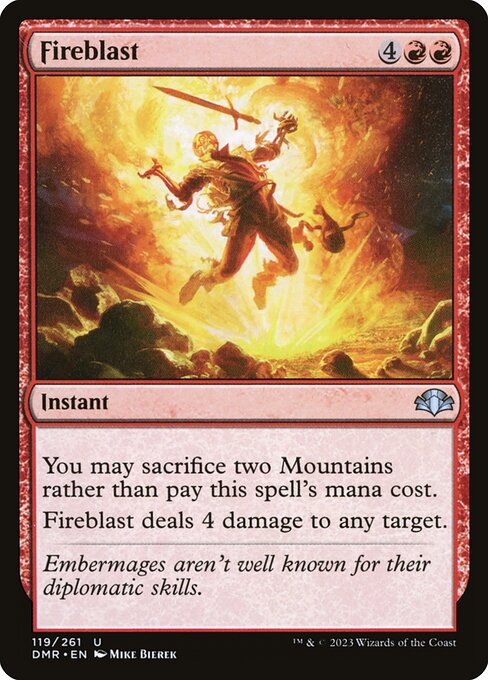
  • 1Fireblast4 manared manared mana

Artifacts (9)

  • 4Experimental Synthesizerred mana
  • 4Inventor's Axered mana
  • 1Mirran Banesplitterred mana

Lands (19)

  • 4Great Furnace
  • 15Mountain

Sideboard (15)

  • 2End the Festivitiesred mana
  • 4Red Elemental Blastred mana
  • 2Relic of Progenitus1 mana
  • 1Cast into the Fire1 manared mana
  • 2Reckless Impulse1 manared mana
  • 2Searing Blazered manared mana
  • 2Suplex1 manared mana

Mono Red Axe

  1. Overview
  2. Decklist

Deck Fundamentals

  1. Introduction
  2. General Strategy
  3. The Cards
  4. Role Assignment
  5. Play Patterns

Introduction

Mono Red Axe is a swarm of cheap red attackers that hit the opponent before they have finished setting up. Reckless Lackey, Clockwork Percussionist, Gingerbrute, and Goblin Tomb Raider (as long as you control an artifact) attack the turn they land, Great Furnace and the artifact creatures put Galvanic Blast into its bigger mode, Inventor's Axe and a kicked Goblin Bushwhacker make the small bodies hit hard, and Lightning Bolt and Fireblast finish from range.

The deck is a small part of the Pauper field at 0.2% of the metagame, so most opponents will see it only occasionally over a tournament. It is a mono-colored deck whose mana never fails to make red, and nearly every spell in it costs a single mana, which makes it one of the cheapest and most direct decks in the format to pick up.

What separates it from a plain pile of red one-drops is the artifact count. The land itself, the artifact creatures, the equipment, and the Blood token from Voldaren Epicure all count, and that count is what turns Galvanic Blast into the best burn spell in the deck and gives Goblin Tomb Raider its haste. Keeping that count up while emptying the hand onto the board is the whole game.

General Strategy

Mono Red Axe wants to put a hasty creature on the battlefield off its first land and attack every turn after that, adding bodies faster than the opponent can block or kill them, then pointing burn at the face once combat has done most of the work. Every card is cheap and almost every card deals damage, so the priority is simple: convert each card in hand into damage as quickly as possible, and never let a turn go by without adding to the board or the burn total. Great Furnace, the artifact creatures, and Inventor's Axe keep enough artifacts in play that Galvanic Blast deals its full damage and Goblin Tomb Raider swings the turn it arrives, which is the one piece of bookkeeping the deck asks of you.

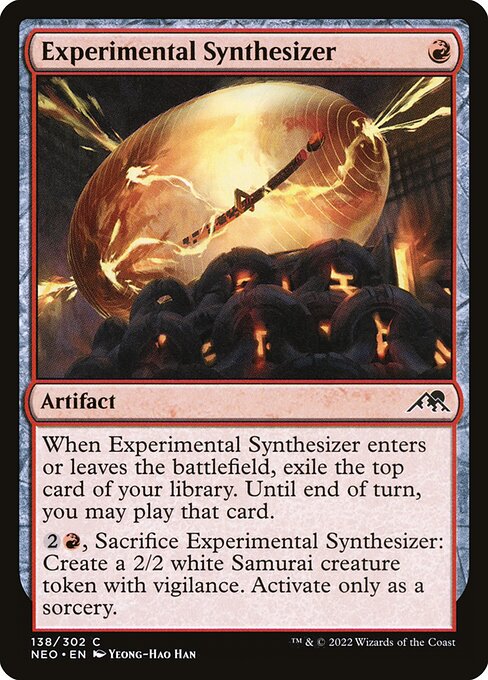
The artifact count is the engine. Great Furnace is an artifact that costs nothing, Clockwork Percussionist and Gingerbrute are artifact creatures, Inventor's Axe is an artifact that doubles as a pump, and Voldaren Epicure leaves a Blood token behind, so three artifacts are on the battlefield within the first couple of turns in most games. That count does two jobs: the first artifact alone gives Goblin Tomb Raider haste and an extra point of power, and it upgrades Galvanic Blast from two damage to four. Meanwhile Experimental Synthesizer flips an extra card when it enters and again when it leaves, and Clockwork Percussionist flips one when it dies, so the hand keeps refilling while the board grows.

A typical game has three phases. The setup is Great Furnace into a hasty one-drop (Goblin Tomb Raider, Reckless Lackey, Clockwork Percussionist, or Gingerbrute) attacking immediately, then one or two more bodies every turn with Inventor's Axe flashed onto whichever attacker gets through. The payoff is the turn the whole board swings together: the last creatures come down, a kicked gives everything haste and an extra point of power, and the attack takes the opponent into burn range. The close is and from range, with cast for free off two basic Mountains as the final burst.

The Cards

Great Furnace

Great Furnace card

The only artifact in the deck that costs no mana, and it counts toward Galvanic Blast's Metalcraft. Play it as your first land whenever you hold Goblin Tomb Raider, since it is what lets the Raider attack for two on the first turn instead of sitting as a 1/2. It is also the artifact opponents can hit with land destruction and artifact removal alike, so keep adding other artifacts rather than treating it as the whole count.

Goblin Tomb Raider
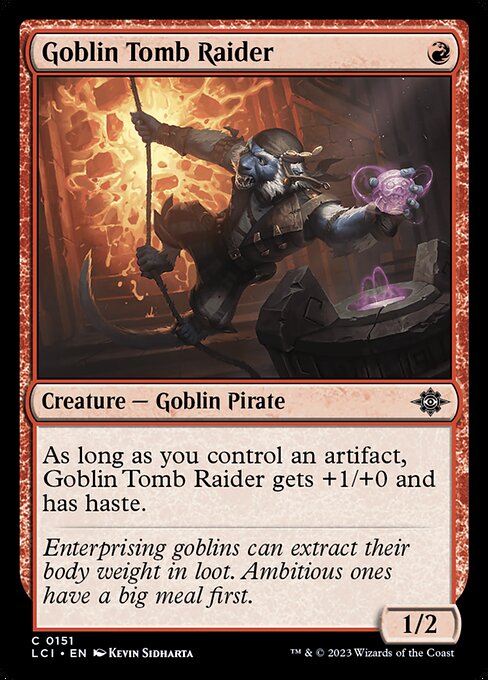
Goblin Tomb Raider card

With an artifact on your side of the battlefield it is a 2-power hasty attacker for one mana, the best rate in the deck; without one it is a 1/2 that waits a turn to attack. Nearly every opening hand puts an artifact down by the time it is cast, so treat it as a two-power haster and plan the artifact count around keeping it that way. Like Reckless Lackey, its two toughness lets it survive the one-damage effects that clear the rest of the team.

Galvanic Blast
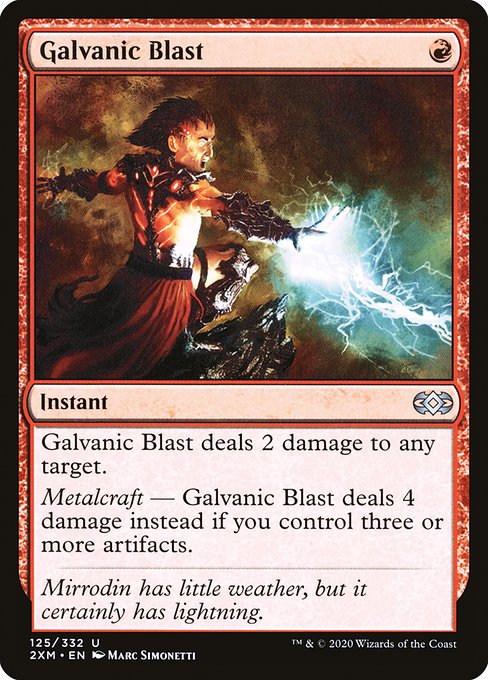
Galvanic Blast card

Two damage for one mana on its own and four once you control three artifacts, which the deck reaches early in most games, so it is usually the best burn spell in hand. The artifact count is checked as it resolves, not as you cast it, so cash in a Treasure, a Blood token, or Experimental Synthesizer only after it has resolved. It goes at the opponent's face by default and is the removal spell to spend when a four-toughness blocker or a lifegain creature is costing more than four damage.

Inventor's Axe
Inventor's Axe card

Role Assignment

Mono Red Axe is a linear, tempo-positive aggro deck with low inevitability: its clock is around the fourth turn, its only interaction is burn (Lightning Bolt, Galvanic Blast, and Fireblast, all of which would rather hit the face), and it has no way to win a long game. That fixes its role in nearly every matchup class as the beatdown. The question in each class is not whether to attack but what is most likely to stop the attack, and the five things that decide a game against this deck are blockers with three or more toughness or first strike, one-damage sweepers and repeatable one-damage effects, lifegain, artifact removal aimed at the count, and whether the opponent's own plan comes online before the fourth turn.

Vs. Aggro. Against another aggressive deck you are still the beatdown, because the deck cannot switch to a controlling posture with burn as its only answers and only thin card advantage, from Reckless Lackey's sacrifice and Experimental Synthesizer's exiled cards, to fall back on. The game is a race decided by who deploys faster and by whether the opponent's creatures outsize the one-power team; when they do, stop attacking into them and let Gingerbrute's evasion and the burn finish instead. The one place burn goes at a creature here is a first striker or a lifelink blocker that turns every attack into a loss: Lightning Bolt on that creature keeps the race on your terms, and Gingerbrute's three-life sacrifice is the buffer that wins a race decided by a single attack.

Vs. Midrange. You are the beatdown, and the axis is three-toughness blockers. A midrange deck stabilizes by putting a body in front of the one-power attackers and then trading its removal one for one with your threats, so the plan is to make each attack cost them something before the board stalls. The play that defines the role is Inventor's Axe flashed in after blockers are declared onto the creature they let through, and Clockwork Percussionist attacking into the big blocker every turn so a block hands you a card. Keep three artifacts around through this phase, because a four-damage is the spell that finishes a midrange opponent sitting just outside range.

Play Patterns

  1. Cast Galvanic Blast while you still control three artifacts, and if you are one short, flash Inventor's Axe in response to your own Blast. The artifact count is read when the Blast resolves, not when you cast it, so anything that removes an artifact in between drops it to two damage: cracking a Treasure for mana or a Blood token for a card, sacrificing Experimental Synthesizer or Gingerbrute, or the opponent killing an artifact in response. The same timing works in your favor with Inventor's Axe: cast on top of the Blast, it resolves first, enters as the third artifact, and the Blast then sees the full count.

  2. Cast every other creature first and a kicked Goblin Bushwhacker last. The kicked trigger affects only the creatures you control as it resolves, so a creature cast after the Bushwhacker gets neither the extra power nor haste. A body without haste of its own, such as Voldaren Epicure, cast after the trigger sits out the attack entirely, and the alpha strike comes up a point or two short of where it needed to be.

  3. Hold Inventor's Axe until blockers are declared, then flash it onto the attacker that got through. The Axe's enters trigger attaches it to a creature you control, and flash lets that happen after the opponent has committed their blocks, so the two extra power land on an unblocked creature and go straight to the life total. Cast it before combat and the opponent simply puts their best blocker in front of the equipped creature, and the pump is spent on a chump block instead.

  4. Cast Experimental Synthesizer before your land drop and while you still have mana left to spend after it. The flipped card is playable only this turn, so a land turned over after you have already played one is lost, and a spell turned over with no mana left is lost too. Casting it first off one land with a second still in hand means a flipped land can be played and a flipped one-drop can be cast. The same order applies when you sacrifice it later for the Samurai: do it with the land drop unused and mana to spare for the second flip.
Continue to Mulligans→
Goblin Bushwhacker
Lightning Bolt
Galvanic Blast
Fireblast

When blockers or removal slow the attack, the deck grinds a little instead of racing blindly. Experimental Synthesizer cast before the land drop is a free card, and later it is sacrificed for a Samurai token and a second card. Clockwork Percussionist attacks into blocks it would lose, because a block trades it for a card. Reckless Lackey is sacrificed for a card and a Treasure before removal takes it for nothing, and spare lands become fresh cards through the Blood token from Voldaren Epicure. Gingerbrute buys a turn either by paying for evasion or by being sacrificed for three life, and all the while Lightning Bolt, Galvanic Blast, and Fireblast stay in hand for the opponent's face.

Two weaknesses matter most in practice. Almost every creature has one or two toughness, so a one-damage sweeper or a creature that deals one damage repeatedly undoes several turns of one-drops for a single card, and the thin refuel means the deck cannot rebuild from that more than once. Artifact removal is the other soft spot: losing Great Furnace, Inventor's Axe, or an artifact creature can take away Goblin Tomb Raider's haste and extra power and drop Galvanic Blast back to two damage, though no single loss does both, because Galvanic Blast needs three artifacts while Goblin Tomb Raider needs only one; spread the count across several artifacts rather than leaning on one.

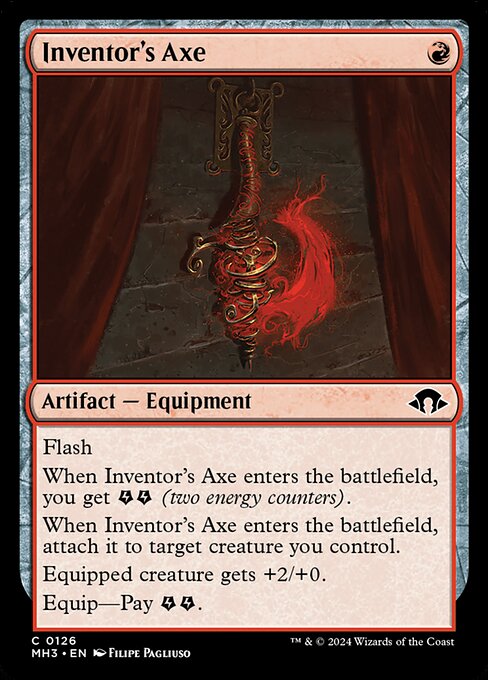
A flash equipment that attaches itself to a creature you control when its enters trigger resolves and gives it two extra power, which turns a one-power attacker into a real clock the moment it hits. Because it has flash, it is a combat trick the opponent cannot block around: wait for blockers before casting it. It is also an artifact for the count, and the two energy it brings pay for one re-equip at sorcery speed after the creature carrying it dies, so an Axe left unattached by removal is not a wasted card.

Experimental Synthesizer

Experimental Synthesizer card

A one-mana artifact that flips the top card of your library when it enters and again when it leaves, with the card playable only that turn. Cast it before your land drop and while you still have mana to spend, so a flipped land can be played and a flipped spell can be cast. Later in the game its sacrifice ability, three mana at sorcery speed, converts it into a 2/2 Samurai and a second flipped card, which makes it the deck's best use of spare mana once the hand is empty.

Voldaren Epicure

Voldaren Epicure card

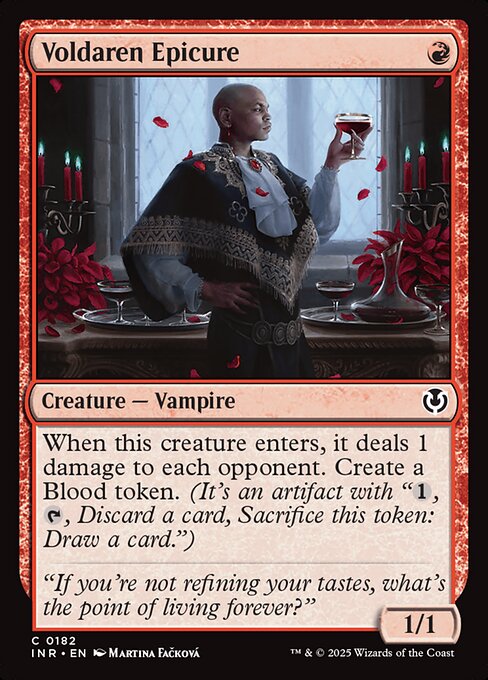
One damage to the opponent when it enters and a Blood token that counts as an artifact from the first turn, which is why it is a strong turn-one play even though the body has no haste and attacks a turn later than the rest of the team. The Blood token has a second job late: for one mana, tapping it, discarding a card, and sacrificing it, a spare land in hand becomes a fresh card. Only crack it after any Galvanic Blast that needed the count has resolved.

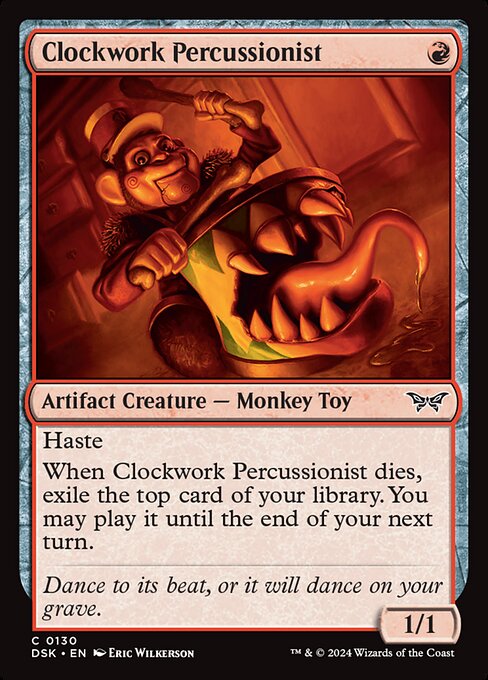
Clockwork Percussionist

Clockwork Percussionist card

A hasty one-mana artifact creature that attacks right away and adds to the artifact count, and whose death flips a card you may play through the end of your next turn. That trigger changes how you attack with it: send it into blockers you would never send another creature into, because a block simply cashes it in for a card while a no-block takes a point of damage. It is the creature to lose first to a trade.

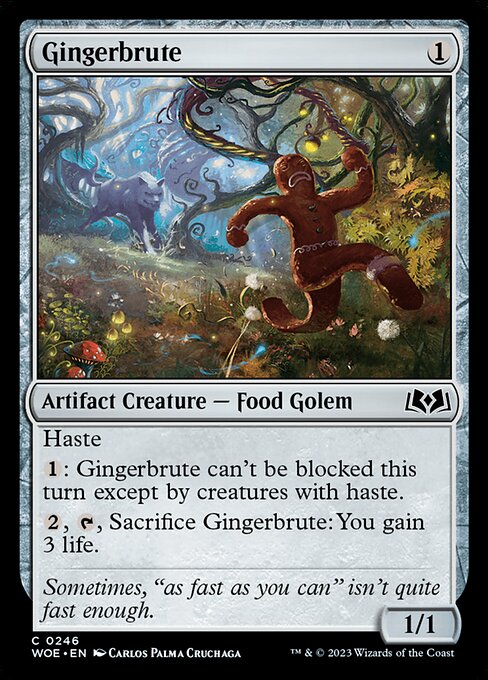
Gingerbrute

Gingerbrute card

A colorless hasty artifact creature any land casts on the first turn. Its evasion activation, one mana to be blockable only by creatures with haste, is how the last few points get through a stalled board, and with Inventor's Axe attached it carries three power that only a hasty creature can block. The sacrifice ability is the deck's only lifegain: two mana, tapping, and sacrificing it gains three life, which buys the extra turn you need to find the last burn spell in a close race.

Reckless Lackey

Reckless Lackey card

A 1/2 first striker with haste, so it attacks on the first turn and kills a one-toughness blocker without taking damage back. Its sacrifice ability, three mana for a card and a Treasure, is the deck's cleanest answer to removal: with the mana available, sacrifice it in response and keep the card. The Treasure is an artifact for the count until you crack it, and it also taps and sacrifices for one mana of any color.

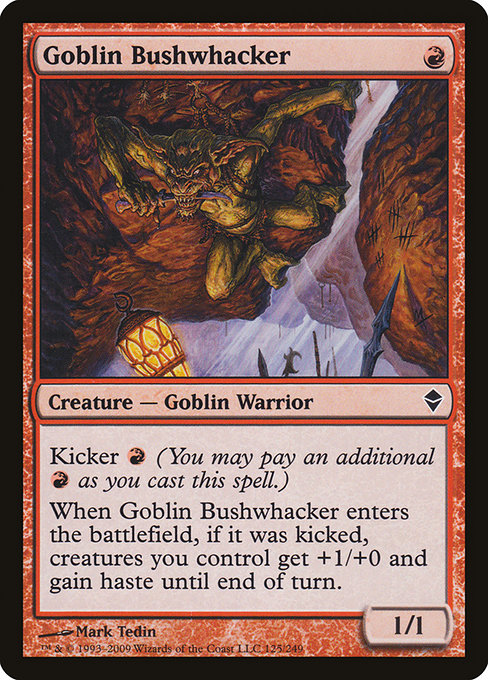
Goblin Bushwhacker

Goblin Bushwhacker card

Cast kicked for two mana, it gives every creature you control haste and an extra point of power for the turn, which is the deck's alpha strike: a board of fresh one-drops suddenly swings as two-power hasters. The boost only applies to creatures already on the battlefield when its trigger resolves, so it is always the last creature cast in the turn. Unkicked it is a one-mana 1/1, which is fine as a body when the hand has nothing else to do.

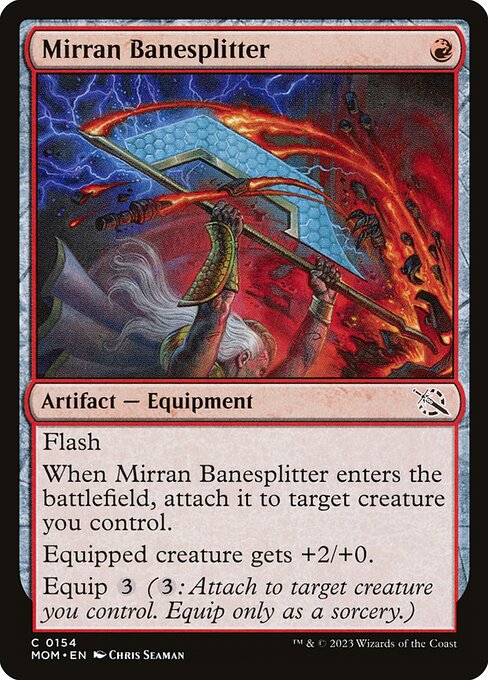
Mirran Banesplitter

Mirran Banesplitter card

The same flash pump as Inventor's Axe: it attaches to a creature you control when its enters trigger resolves, adds two power, and counts as an artifact. The difference is the re-equip cost of three mana, so it is a one-shot attachment in practice and the one to flash in where the creature is safest from removal, with the three-mana equip reserved for a late game where mana is spare.

Lightning Bolt

Lightning Bolt card

Three damage at instant speed for one mana, and it goes at the opponent's face in almost every game. It is spent on a creature only when killing that creature adds more damage than three: a first striker that blanks the whole team, a lifegain body that keeps pushing the opponent out of burn range, or the single blocker standing between a lethal attack and the face.

Fireblast

Fireblast card

Printed at six mana, it is almost always cast for free by sacrificing two basic Mountains you control, and it deals four damage at instant speed. Great Furnace is not a Mountain, so count only basics toward the free cost and lean toward Mountains on later land drops when you are holding it. Sacrificing two lands ends your development, which makes it the last spell of the game: hold it for the final four points at the face, not for a creature.

Galvanic Blast
Lightning Bolt

Vs. Control. Against control you are unambiguously the beatdown: the deck has no inevitability, so every turn the game runs long favors the opponent. A control deck's counterspells trade one for one with threats that cost a single mana, which is a trade you are happy to take all day, and its sweepers punish a hand emptied onto the board. The defining play is deploying two or three creatures a turn while keeping the burn in hand, so a sweeper costs them a card for your cheapest bodies and Lightning Bolt, Galvanic Blast, and Fireblast finish from the hand after the board is gone. Experimental Synthesizer is the card that keeps the threats coming once the opening hand is spent.

Vs. Combo. You are the beatdown by default, and there is no second plan: the burn cannot touch a combo engine unless it happens to be a creature, so in game one the only disruption is speed, and the sideboard adds only narrow answers such as Red Elemental Blast for a blue engine and Relic of Progenitus for a graveyard one. Every spell goes toward the fastest kill, Voldaren Epicure's entry damage included, and nothing is held back for a blocker that will never come. The play that shows the role is the kicked Goblin Bushwhacker turn: cast the rest of the hand first, kick the Bushwhacker last, and swing with everything the turn it brings the opponent into Fireblast range.

  • Play Great Furnace as your first land when you hold Goblin Tomb Raider, and count only basic Mountains toward Fireblast's free cost. The Raider has haste and its extra power only while you control an artifact, and the Furnace is the one artifact that costs no mana, so leading with it turns a turn-one Raider into an immediate two-damage attack. Fireblast's alternative cost sacrifices Mountains by land type, which Great Furnace is not, so a draw heavy on Furnaces strands the finisher as a six-mana spell: once the Raider has its artifact, prefer basic Mountains for the following land drops when Fireblast is in hand.

  • Attack with Clockwork Percussionist into blockers you would never send another creature into. Its death trigger flips the top card of your library and lets you play it through the end of your next turn, so the opponent is choosing between taking a point of damage and spending a block to hand you a replacement card. Either outcome is fine for you, which makes the Percussionist, along with a Gingerbrute paying for its evasion, an attacker that keeps swinging into a stalled board while the rest of the team waits for the Inventor's Axe or the kicked Goblin Bushwhacker turn.