







Skip to content
Deck Guides
  1. Pauper
  2. /Esper Ninja Affinity
Sign in
PrimerMulligansSideboardMatchupsCommunity


© 2026 Deck Guides LLC
AboutTerms of ServicePrivacy PolicyRefund PolicySupport
PrimerMulligansSideboardMatchups
Springleaf Drum card art representing Esper Ninja Affinity

Esper Ninja Affinity

white manablue manablack mana

November 2026 · 1.0% Meta · 3 hr 12 minNovember 2026 Version · 1.0% Meta · 3 hr 12 min read

Esper Ninja Affinity is an aggressive artifact deck. Artifact lands, Springleaf Drum and the Clue tokens from Thraben Inspector and Novice Inspector make Utrom Monitor, Frogmite, Refurbished Familiar and Myr Enforcer far cheaper than printed. The Inspectors attack early, and when they get through, Moon-Circuit Hacker or Leonardo, Big Brother takes their place in combat and sends them back to hand to be recast for more Clues. The deck wins by attacking with its fliers and Myr Enforcer while Dispatch removes the blocker that matters.

Decklist

Creatures (31)

  • 4Novice Inspectorwhite mana
  • 4Thraben Inspectorwhite mana
  • 4Moon-Circuit Hacker1 manablue mana
  • 3Leonardo, Big Brother2 manawhite mana
  • 4Frogmite4 mana
  • 4Refurbished Familiar3 manablack mana
  • 4Utrom Monitor4 manablue mana
  • 4Myr Enforcer7 mana

Instants (4)

  • 4Dispatchwhite mana

Sorceries (4)

  • 4Thoughtcast4 manablue mana

Artifacts (4)

  • 4Springleaf Drum1 mana

Lands (17)

  • 4Ancient Den
  • 2Goldmire Bridge
  • 2Mistvault Bridge
  • 4Razortide Bridge
  • 4Seat of the Synod
  • 1Vault of Whispers

Sideboard (15)

  • 4Hydroblastblue mana
  • 3Dry Spell1 manablack mana
  • 4Dust to Dust1 manawhite manawhite mana
  • 4Metallic Rebuke2 manablue mana

Esper Ninja Affinity

  1. Overview
  2. Decklist

Deck Fundamentals

  1. Introduction
  2. General Strategy
  3. The Cards
  4. Role Assignment
  5. Play Patterns

Introduction

Esper Ninja Affinity is an aggressive artifact deck. Artifact lands, Springleaf Drum and the Clue tokens from Thraben Inspector and Novice Inspector make Utrom Monitor, Frogmite, Refurbished Familiar and Myr Enforcer cost a fraction of what is printed on them. Unblocked Inspectors are swapped in combat for Moon-Circuit Hacker or Leonardo, Big Brother, then replayed for more Clues and cards. The deck wins by attacking, in the air and with Myr Enforcer on the ground, while Dispatch exiles the blocker that matters.

The deck makes up 1.0% of the field. Dispatch became legal in tabletop Pauper on September 7, 2026, as one of the Zeta Set cards downshifted to common. In a deck whose lands are artifacts, it is cheap removal that exiles from the early turns onward.

Results followed quickly. seasonofmists finished 4th with an 8-1 record in the Pauper Challenge 32 on September 25, 2026, and Lombi went 6-2 in a Challenge 32 dated September 21. The deck has kept posting Challenge finishes through October.

General Strategy

Esper Ninja Affinity wins by getting artifacts onto the battlefield early and letting them pay for everything else. Artifact lands, Springleaf Drum and the Clue tokens from Thraben Inspector and Novice Inspector all count as artifacts. Utrom Monitor, Frogmite, Refurbished Familiar, Myr Enforcer and Thoughtcast each get cheaper for every artifact you control. A normal draw lands its creatures well ahead of the mana they are printed at, so the opponent faces fliers and the deck's largest creature before their own plan is running.

What matters most is the artifact count in the opening turns. Judge every early choice (which land to play, which spell to cast first, whether to sacrifice a Clue for a card) by what it does to that count, because a hand of discounted threats is only as good as the artifacts on the table. The rest of the plan happens in combat. An Inspector attacks, and if the opponent lets it through, Moon-Circuit Hacker or Leonardo, Big Brother takes its place and the Inspector returns to hand to be cast again for another Clue.

Four artifacts is the count to aim for. At four, Frogmite is free, Utrom Monitor and Thoughtcast each cost a single blue mana, and Myr Enforcer costs three. Refurbished Familiar needs only three artifacts to cost a single black. Two artifact lands and a Clue get you most of the way, and Springleaf Drum or a second Inspector finishes the job.

The combat swap keeps the count growing. Moon-Circuit Hacker's ninjutsu or 's sneak returns an unblocked Inspector to hand, and the Inspector comes back down with a new Clue. Hacker draws a card the turn it arrives, and refills the hand when it runs low. None of this goes infinite: each swap adds a creature, an artifact and, with Hacker, a card.

The Cards

Springleaf Drum
Springleaf Drum card

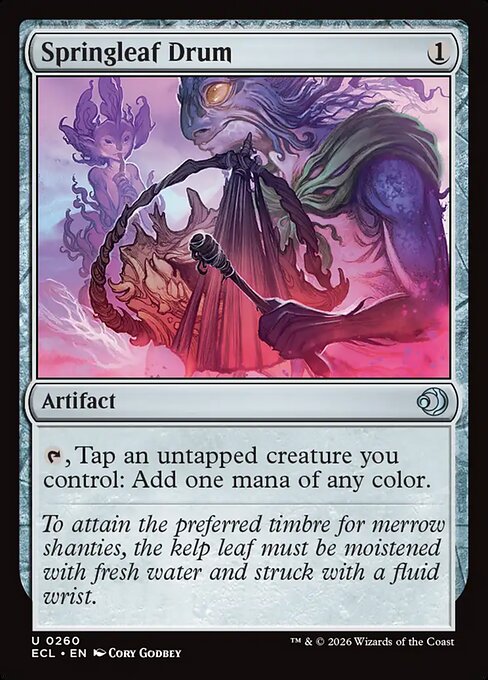
For one mana it adds an artifact to the count and turns any creature into a mana source of any color. It can tap a creature that came down this turn, so an Inspector cast alongside it pays for something right away. It is also how the deck most often fixes its colors. Beyond the five lands that make black, Drum is the only way to cast Refurbished Familiar, and it supplies the second color when your lands only make one of white and blue.

Thraben Inspector
Thraben Inspector card

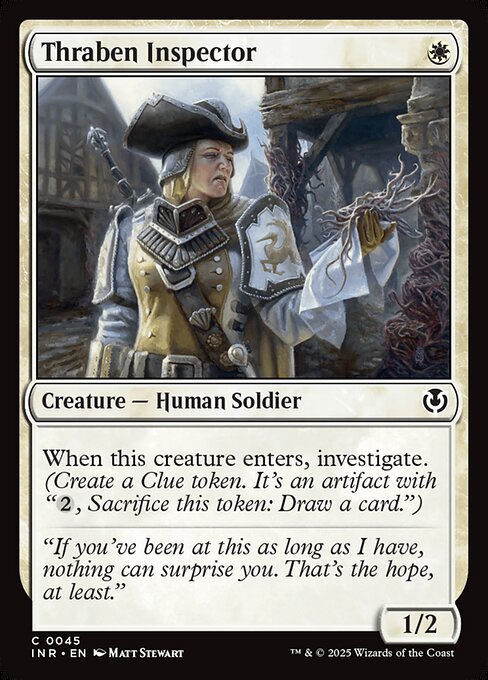
Novice Inspector is the same card under a second name, and the two fill one role. One white mana buys a 1/2 and a Clue, so each Inspector brings a creature and an artifact at once. They are the attackers the ninjas come in for, and returning one to hand means casting it again for another Clue. Later in the game the Clues turn spare mana into cards at two mana each. Until the affinity spells have resolved, a Clue is usually worth more on the battlefield as an artifact than as a card.

Moon-Circuit Hacker

Moon-Circuit Hacker card

Printed as a two-mana 2/1, it almost always enters through ninjutsu for a single blue, replacing an unblocked attacker after blocks. The turn it enters, its combat damage draws a card with no discard. On later turns the draw comes with a discard, which still turns extra lands or a second Leonardo, Big Brother into fresh cards. Ninjutsu is an ability, not a spell, so a counterspell cannot stop it.

Leonardo, Big Brother

Role Assignment

Vs. Aggro. Against a faster aggro deck you are the control. You have no direct damage and no lifegain, so you cannot win a pure race against a deck that can finish with burn. You do win the long game: Clues, Thoughtcast and Myr Enforcer give you more card advantage and bigger creatures than a low-curve deck can match. The Inspectors block, Enforcer holds the ground, and Dispatch exiles the one creature that would outrace you. The play that shows the role is keeping an Inspector home as a blocker when the ninja swap would leave you open on the opponent's turn. Blocker density cuts both ways here. A wide board of cheap untapped creatures shuts off ninjutsu and sneak, so the fliers do the attacking once you have stabilized.

Vs. Midrange. Against midrange you are the beatdown, and tempo is the advantage. Affinity lands Myr Enforcer and Utrom Monitor before the opponent's mana lines up answers for both. The shape of their removal decides how hard you push. One or two damage clears Moon-Circuit Hacker, Refurbished Familiar, the Inspectors and Frogmite, while Enforcer and Monitor demand a real removal spell. The ground usually stalls against their larger creatures, so the demonstrating play is to stop attacking into those creatures and send only the fliers. Dispatch is held for the one creature that can block them. Your card advantage lets you stay the aggressor after a round of trades, which a typical aggro deck cannot do.

Vs. Control. Against control you are the beatdown, because control has inevitability and a soft clock gives it time to use it. Your interaction is Dispatch and the discard from Refurbished Familiar, so you win by presenting more threats than they have answers. The demonstrating play is returning an unblocked Familiar to hand under a ninja and casting it again. That adds pressure and takes another card from a hand that needs every answer. The card-advantage race is closer than it looks, since Clues and rebuild after a sweeper. Commit enough to force the sweeper, and keep the refill for the turn after it.

Play Patterns

  1. Attack with your Inspectors before casting anything, keep a blue or white source untapped through the declare blockers step, and cast everything else in the second main phase. Ninjutsu and sneak only exist after blockers are declared, so mana spent before combat strands Moon-Circuit Hacker or Leonardo, Big Brother in hand. The affinity creatures cannot attack the turn they arrive, so waiting costs them nothing, and the Inspector that returns comes back with a Clue that makes them cheaper. With Novice Inspector and its Clue in play and a second artifact land on turn two, Frogmite would cost one mana before combat. Attack first: if the Inspector is unblocked, one land pays for Hacker's ninjutsu, the other recasts the Inspector, and the second Clue makes four artifacts, so Frogmite costs nothing. The one exception is when the mana you are holding comes from Springleaf Drum. Drum needs an untapped creature and your attackers are tapped, so cast one creature before combat to give it something to tap.
  2. Point Dispatch at the creature that would block before blockers are declared, not at a creature that has already blocked. An attacker stays blocked after its blocker is exiled, so a late Dispatch pushes no damage through and does not reopen the window for Moon-Circuit Hacker, which needs an unblocked attacker. Before blocks it clears the lane. With fewer than three artifacts the tap alone still keeps that creature from blocking this turn, while tapping a creature that has already blocked changes nothing about the block.
  3. Cast your artifacts from cheapest to most expensive: Springleaf Drum or an Inspector first, then Frogmite, then Utrom Monitor or Refurbished Familiar, then Myr Enforcer. Affinity counts only the artifacts already on the battlefield, so each one that resolves lowers the cost of the next. With four artifacts out, Enforcer costs three, and a free resolved first makes it two. That one mana is often the difference between the 4/4 arriving this turn or next. An Inspector counts through its Clue, so let its trigger resolve before you price the next spell.
Continue to Mulligans→
Leonardo, Big Brother
Thoughtcast

A game starts with an untapped artifact land casting an Inspector. The following turn, a second artifact land plus Springleaf Drum or a second Inspector completes the count. Then Utrom Monitor or Refurbished Familiar comes down for one colored mana and Frogmite for nothing, while the first Inspector attacks to set up the swap. Myr Enforcer follows for a mana or two and Thoughtcast refills the hand.

Every win comes through combat damage. Utrom Monitor and Refurbished Familiar attack in the air, Myr Enforcer and Frogmite attack on the ground, and Leonardo, Big Brother grows with every creature beside him. Dispatch exiles whichever blocker would stop the swap or the final attack.

When artifact removal shrinks the count or a sweeper clears the cheap creatures, the deck stops racing and plays a longer game. It sacrifices Clues for cards, casts Thoughtcast, and replays Inspectors to rebuild the count. Myr Enforcer's 4 toughness holds the ground, and Razortide Bridge, Goldmire Bridge and Mistvault Bridge are indestructible, so part of the count survives most artifact removal. Refurbished Familiar keeps coming back to strip the opponent's answers, and Dispatch waits for the single threat that would otherwise race the rebuilt board.

The deck's first weakness is that almost everything is an artifact, lands included. Removal aimed at Ancient Den, Seat of the Synod or Vault of Whispers costs a land and a discount at once, and the Bridges can still be exiled or sacrificed. Below four artifacts, Myr Enforcer, Utrom Monitor and Thoughtcast cost real mana again. Below three, Dispatch stops exiling.

The second weakness is that the ninja plan needs an unblocked attacker. Several cheap untapped blockers, or a single blocker with first strike or deathtouch, keep the Inspectors at home. Moon-Circuit Hacker and Leonardo, Big Brother then have to be cast at full price. When that happens, the fliers become the way through.

Leonardo, Big Brother card

Leonardo costs three mana as printed, and he usually arrives for a single white through sneak, entering tapped and attacking in place of an unblocked attacker. He gains power for every other creature you control, so on a full board he is the hardest hitter in the deck and often the final points of damage. Sneak is a cast spell, unlike ninjutsu. If it is countered, the attacker you returned is already back in hand and its damage is lost. He is legendary, so a second copy waits in hand while the first is on the battlefield.

Frogmite

Frogmite card

Four mana on the card, free with four artifacts out. The 2/2 matters less than what it adds: it is an artifact itself, so it lowers the cost of every affinity spell cast after it, and it gives Springleaf Drum a creature to tap.

Myr Enforcer

Myr Enforcer card

Printed at seven mana, it costs three with four artifacts out, and every artifact beyond that takes off another until it is free. The 4/4 is the largest creature in the deck and the one that survives damage-based removal and sweepers that clear the rest of the board. It holds the ground on defense and forces a real answer on offense.

Utrom Monitor

Utrom Monitor card

A five-mana 3/3 flier on the card, and a single blue mana with four artifacts out. It is the deck's main source of damage in the air. The ground often stalls against larger creatures, and Monitor keeps attacking over that stall while adding one more artifact to the count.

Refurbished Familiar

Refurbished Familiar card

Printed at four mana, it costs a single black with three artifacts out. It brings a 2/1 flier and makes the opponent discard a card of their choice, or draws you a card when their hand is already empty. Flying means it is often the unblocked attacker, so a ninja can return it to hand and it comes down again for another discard. Black is the deck's lightest color. Only Goldmire Bridge, Mistvault Bridge, Vault of Whispers and Springleaf Drum make it, so check for one of them before counting on Familiar.

Thoughtcast

Thoughtcast card

The refill. Five mana as printed, a single blue with four artifacts out, and two fresh cards for a deck that empties its hand quickly. It is a sorcery and not an artifact, so it does nothing for the count. Cast it after the artifacts are down, when it is cheapest and you know what the hand is missing.

Dispatch

Dispatch card

The only removal spell in the main deck. For one white mana at instant speed it exiles any creature once you control three artifacts, and two artifact lands plus a Clue or Springleaf Drum is enough. Exile gets around death triggers, regeneration and indestructible. Without three artifacts it only taps the creature, which still keeps that creature from blocking for the turn. Save it for the blocker that stops your attack or the one threat that would win a race against you.

Thoughtcast

Vs. Combo. Against combo you are the beatdown with almost nothing else to fall back on. A combo deck wins the long game by definition. Dispatch has no target against a creatureless combo, and the opponent chooses what Refurbished Familiar takes. You have little that stops the combo, so your plan is to finish before it. The deck's clock sits around turn five. The demonstrating play is spending every mana on the board: leave Clues uncracked, cast the affinity creatures as soon as the count allows, and sneak Leonardo, Big Brother for the largest hit available. When the combo runs through a creature, the role softens: Dispatch exiles that creature at instant speed, and holding one white mana for it is worth more than one extra attacker.

Frogmite
  • When a ninja comes in, return the creature whose enters trigger you want again. You choose which unblocked attacker goes back to hand. Thraben Inspector or Novice Inspector replays for one white and adds an artifact to the count. Refurbished Familiar replays for one black with three artifacts out and takes another card from the opponent's hand. Returning a creature with no trigger gains nothing beyond the arrival of Moon-Circuit Hacker or Leonardo, Big Brother.
  • Crack Clues only when the artifact count has slack: never below three with Dispatch in hand, and never below what your next affinity spell needs. A sacrificed Clue leaves the battlefield and lowers the count. Cracking one at the wrong moment turns Dispatch's exile into a tap and adds a mana to the next Myr Enforcer or Thoughtcast. Cash in the Clues from Thraben Inspector and Novice Inspector after the affinity spells have resolved, or when you have artifacts to spare.
  • When you sneak Leonardo, Big Brother, count his power on the board as it stands after the swap. The creature you returned is already in hand when damage is dealt. His power is one plus the other creatures you still control, attacking or not, and the returned attacker's own damage comes off the total. Sneaked off a lone Inspector he hits for 1. Sneaked off an Inspector that attacked beside three other creatures he hits for 4. Work out lethal from that board, not from the one you attacked with.